
Is Your Roach Treatment Working: Signs of Progress and Stalling
Live sightings are the worst measure of progress. How to read fresh droppings, dead insects and trap catch rates...

Not all cockroaches behave the same way, and the species you have determines almost everything about how you should treat it. German and American cockroaches differ in size, in where they nest, in how they get into a building, and in what actually kills a population. Treating one as though it were the other is the most common reason a competent-looking treatment does nothing. For the full clearance sequence after identification, follow the 21-day German roach infestation treatment plan.
This guide covers how to tell them apart in a few seconds, why each species requires a different strategy, and what to do first in each case.
| Feature | German cockroach | American cockroach |
|---|---|---|
| Adult length | About 13 to 16 mm, roughly half an inch | Up to 40 to 50 mm, close to two inches |
| Colour | Light tan to brown | Reddish-brown with a pale yellowish margin behind the head |
| Markings | Two dark parallel stripes running down the shield behind the head | A pale figure-of-eight or ring pattern on the shield |
| Flight | Wings present but rarely used for sustained flight | Capable of gliding flight, especially in warm conditions |
| Speed and behaviour | Very fast, stays close to harbourage, hides in tight crevices | Fast but more willing to cross open floor and travel long distances |
| Where it nests | Exclusively indoors, in warm humid cavities near food and water | Damp organic outdoor areas, sewers, drains, crawl spaces and basements |
| Egg case | Carried by the female until roughly a day before hatching | Dropped or glued into a crevice soon after forming |
| Eggs per case | 30 to 40 | 14 to 16 |
| Typical problem | Rapidly growing indoor breeding population | Repeated entry from outside or from plumbing |
If the insect is small, tan, and disappeared into a crevice before you got a proper look, assume German. If it is large, reddish, and was crossing a basement or bathroom floor, assume American. If you are looking at something very small and dark, it may be a nymph of either species rather than a different insect; our guide to identifying cockroach nymphs covers the differences.
German cockroaches are the species that produces the classic infestation, and they are difficult for one reason above all others: reproductive speed. A female carries an egg capsule of 30 to 40 eggs attached to her abdomen until it is nearly ready to hatch, which means the eggs stay in the safest part of the harbourage right up to the last day. Populations therefore grow in waves and can rebuild from a very small number of survivors.
They nest exclusively indoors and they will not survive outside in most climates, which is genuinely useful information: if you have German cockroaches, the nest is inside your building, and probably inside a cavity you can identify.
Precise, non-repellent baiting inside the harbourage cavities, left undisturbed for several weeks. Because the colony lives in voids you cannot reach directly, control depends on foraging insects carrying material back inside. Anything repellent defeats that, which is why aerosols and foggers make the situation worse rather than better; see why sprays make German roaches scatter.
American cockroaches, often called palmetto bugs in the southern United States, are a fundamentally different problem. They breed in damp organic environments, mostly outdoors or in sewers, drains, crawl spaces, and basements, and they enter buildings looking for water or escaping a change in conditions such as heavy rain or drought. Seeing one indoors usually means a route in rather than a nest behind your cabinets.
Exclusion and moisture control do most of the work, with baiting used to intercept whatever gets in. Because the source is usually outside the living space, treating the kitchen repeatedly achieves very little.
Treating an American cockroach problem with an intensive interior kitchen baiting programme, or treating a German cockroach problem by sealing the exterior and spraying the perimeter. Both are competent work aimed at the wrong species. The tell is location and repetition: if large reddish insects keep appearing near drains and basements no matter what you do indoors, you have an exclusion problem. If small tan insects and droppings keep appearing inside cabinets, you have an indoor nest and no amount of exterior work will touch it.
A related error is assuming a monthly exterior perimeter spray covers both. For an indoor German cockroach population living inside a cabinet carcass it does almost nothing, which is the situation described in why a monthly spray is not working.
If neither description fits, two more are worth knowing. Oriental cockroaches are dark, almost black, glossy, and strongly associated with damp basements, drains and crawl spaces, and they are treated much like American cockroaches. Brown-banded cockroaches are small and tan like German cockroaches but prefer drier, higher locations such as ceiling corners, picture frame backs, upper cabinets and the inside of electronics, so placements need to go up rather than down.
Droppings are often the fastest way to settle the question, because size and shape differ clearly between species. Our guide to identifying cockroach droppings includes a comparison table.
In most everyday usage yes. Palmetto bug is a regional name applied mainly to the American cockroach and sometimes to other large outdoor species. The treatment approach is exclusion and moisture control rather than intensive indoor baiting.
German cockroaches are far harder to eliminate because they breed rapidly and exclusively indoors, so a small number becomes a large population quickly. American cockroaches are larger and more alarming to encounter but usually represent entry rather than an established indoor colony.
Yes, and it is reasonably common in older buildings, where a German population lives in the kitchen while American cockroaches enter through basement drains. The two require different responses running in parallel: baiting the interior harbourage and sealing the plumbing and perimeter.
No. They are separate species and do not hybridise, which is why identification remains reliable and why the treatment distinction holds.
Two minutes spent establishing whether the insect is small and tan with two stripes or large and reddish will save you weeks. German cockroaches mean an indoor nest and a sustained, non-repellent baiting programme inside cavities. American cockroaches mean a route in, and the fix is exclusion and moisture control with bait at the entry points.
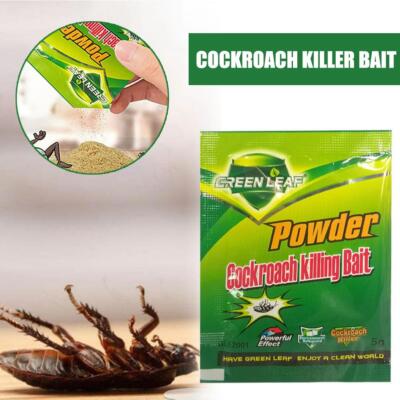
For either species, GreenLeaf RoachBuster provides 50 odorless, stainless dry powder sachets per box, which is enough to run interior harbourage placements for a German population or intercept placements along entry routes for an American one. Always use as directed on the product label, and keep placements away from children and pets.
Treating an active infestation? One box treats one room, once. The 3-Box Kit — $120 (150 sachets, save $59.97) covers a full apartment through the complete 3-4 week treatment cycle; a $47 single box (50 sachets) covers a single-room problem. Ships within 1 business day, typical delivery 6-10 days · Free tracked shipping · 30-day money-back guarantee.
Choose your kit →

Live sightings are the worst measure of progress. How to read fresh droppings, dead insects and trap catch rates...
A resurgence at three weeks and a resurgence at three months are different problems. The six causes of reinfesta...

Powder sachets, aerosols and total-release foggers work on completely different principles. Which one reaches th...
Your anonymous feedback helps us improve our educational home defense resources.