
Roach Control for Multi-Unit Buildings: A Landlord Treatment Plan
Treating one flat in a connected block fails predictably. How to survey across unit boundaries, quantify a build...

If you pay for a monthly pest control service but continue to see cockroaches returning every few weeks, you are not alone. Many homeowners and tenants find themselves trapped in a frustrating cycle of chemical treatments followed by temporary relief, only for the infestation to return. The cause is a well-known biological phenomenon: the nest dispersal trap. Roaches walking past your placements? See the five real reasons in roach bait not working, then compare formats in our best roach killer powder guide.
Most standard exterminator packages rely on monthly spraying of liquid chemical barriers along kitchen and bathroom baseboards. These liquid sprays contain strong synthetic pyrethroids designed to act as visual repellents. When cockroaches detect these chemical residues, their survival instinct triggers a scatter response. Instead of walking through the spray and dying, the colony splits, retreats deep into the wall cavities, and migrates to untreated zones (like adjacent rooms or neighboring apartments).
As the chemical residue degrades over the course of 2 to 3 weeks, the scattered colonies migrate back to your kitchen cabinets and countertops to forage for food, giving the illusion of a new infestation and forcing you to call the exterminator for another treatment.
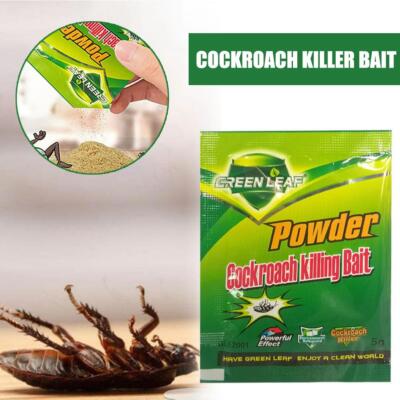
To break this cycle, you must stop repelling the pests and start attracting them to a targeted active bait. A non-repellent dry powder bait does not scatter the nest. RoachBuster dry powder sachets utilize an odorless, non-repellent borate formulation that pests consume naturally without alarm.
The foraging roaches ingest the powder and carry fine particles back on their legs to the nesting voids inside walls. Through natural contact and grooming, the active ingredient spreads throughout the nesting center, eliminating the colony at its source instead of scattering them into neighboring walls.
Deciding what to do next: our comparison of DIY versus professional treatment costs sets out when a licensed technician is genuinely the right call and when the money is better spent elsewhere.
Next steps: how powder, sprays and foggers differ, how to tell whether a treatment is working, and how many sachets a full round actually takes.
A monthly perimeter and interior spray service is a business model before it is a treatment strategy. It produces predictable recurring revenue, it can be delivered by a technician in fifteen to twenty-five minutes per property, it requires no diagnosis, and it generates a visible service event that customers feel they have paid for. None of that makes it dishonest. It makes it optimised for scheduling and consistency rather than for eliminating a specific population in a specific building.
For some pest categories, that is fine. For German cockroaches living in wall voids, appliance cavities and plumbing chases, a fifteen-minute perimeter application on a fixed calendar is structurally mismatched with the problem.
| Element | Mismatched service | Effective programme |
|---|---|---|
| First visit | Perimeter spray, 20 minutes | Full inspection with appliances moved, 60 to 90 minutes |
| Diagnosis | Assumed | Harbourage located and recorded |
| Product choice | Same product every visit | Non-repellent bait matched to the species and situation |
| Coverage | Accessible surfaces | Voids, cavities, plinths, appliance bays, boundaries |
| Follow-up | Next month | 14 days and 30 days, tied to the life cycle |
| Neighbours | Not considered | Whole stack or adjoining units in multi-unit buildings |
| Exclusion | Rarely included | Sealing, sweeps, drain covers as part of the scope |
| Records | Visit log | Numbered placement plan plus findings |
A provider who answers those eight questions confidently is worth keeping regardless of their pricing model. A provider who cannot answer any of them is selling a schedule, not a solution.
Householders often assume they must choose between a contract and self-treatment. In practice the two combine well provided you use a non-repellent bait rather than a spray, because bait does not conflict with a professional programme the way an aerosol does. Place in the cavities and boundaries the technician does not reach, keep a written placement log, and tell the technician what you have placed so they can factor it in. If the service is spray-based and repellent, that combination is less productive, and it is a reasonable conversation to have with the provider. Placement counts are in our coverage arithmetic guide and the recurrence patterns to watch for are in our reinfestation guide.
Not necessarily. Ask the eight questions above first. Many providers will change the approach for a specific problem if asked directly, and some are excellent.
Ant activity is often surface-based and seasonal, so a perimeter residual can genuinely interrupt it. German cockroaches breed in inaccessible voids year-round, which is a different problem.
A thorough one-off inspection and bait programme with two follow-ups often outperforms a year of fifteen-minute monthly visits for a cockroach problem specifically.
Falling counts on overnight monitors and placements no longer being consumed, over a four to six week window. Our progress guide sets out the signals.
Monthly spraying is optimised for scheduling, not for populations living in voids. It mistimes the hatch window, treats the wrong surfaces, disperses aggregations and does not allow time for diagnosis. Ask your provider the eight questions, insist on inspection with appliances moved, and place non-repellent bait in the cavities and boundaries yourself. One box covers a whole home alongside any service, with a 30-day money-back guarantee.
Always use any product as directed on its label, and keep placements out of reach of children and pets. Product formulations, approvals and labels differ between markets and change over time, so read the label of the specific product you buy rather than relying on general category descriptions.
Treating an active infestation? One box treats one room, once. The 3-Box Kit — $120 (150 sachets, save $59.97) covers a full apartment through the complete 3-4 week treatment cycle; a $47 single box (50 sachets) covers a single-room problem. Ships within 1 business day, typical delivery 6-10 days · Free tracked shipping · 30-day money-back guarantee.
Choose your kit →

Treating one flat in a connected block fails predictably. How to survey across unit boundaries, quantify a build...
A resurgence at three weeks and a resurgence at three months are different problems. The six causes of reinfesta...

Found roaches tonight? The first 48 hours decide whether your treatment works. Hour one containment, the after-d...
Your anonymous feedback helps us improve our educational home defense resources.