
Roach Emergency Plan: What to Do in the First 48 Hours
Found roaches tonight? The first 48 hours decide whether your treatment works. Hour one containment, the after-d...
Baiting is uncomfortable precisely because nothing appears to happen at first. There is no satisfying instant result to confirm you did it right, so the temptation is to change tactics on day three, spray over the top, or move everything around. Almost every one of those interventions makes the outcome worse. This is how to read the evidence properly, so you know whether to hold your nerve or actually change something. Our breakdown of realistic roach treatment timelines shows what progress should look like week by week.
Live sightings are the worst indicator of progress, because they are driven by when you happen to walk into a room. These four are far more reliable.
| Signal | What to look for | What it tells you |
|---|---|---|
| Fresh droppings | New dark specks in a treated void since you last wiped it | The most direct measure of current activity |
| Dead insects in the open | Bodies on floors and worktops, often on their backs | Uptake is happening and the product is moving |
| Trap catch rate | Catches per trap per night, same traps, same spots | A comparable number over time |
| Nymph proportion | Ratio of small pale insects to adults | Tells you whether breeding is continuing |
The trick with droppings is to create a clean baseline. Wipe one small marked patch inside each treated void, note the date, and check it every few days. Anything new on that patch is current activity. Without a baseline you are looking at a mixture of old and new evidence and guessing. The droppings guide covers identification and safe cleaning.
The reasoning behind those intervals is set out in the week-by-week timeline. If a second wave arrives on schedule, that is biology rather than failure — the egg case guide explains why.
There is a real difference between slow and stuck. Treat these as evidence that something needs to change, not just more time.
Work through these in order — they are ranked by how often they turn out to be the answer.
| Check | Likely problem | Fix |
|---|---|---|
| Are placements inside the void or near it? | Sited in the open, not in the harbourage | Move to the rear of cavities and appliance voids |
| Is there a drip, condensation or standing water? | Water outcompetes treatment | Fix the leak, dry the sink nightly |
| Have you sprayed anywhere nearby? | Repellent residue suppressing uptake | Stop spraying, clean the area, re-place |
| Is open food still available? | Bait competing with a better meal | Seal dry goods, lift pet bowls, empty bins nightly |
| Did you treat every room? | Harbourage in an untreated area | Trap survey in all rooms, widen the map |
| Did you run out mid-round? | Incomplete coverage | Complete the round properly — see the coverage math |
| Shared walls or risers? | External supply line | Seal penetrations, escalate to the building |
The two most common answers by a wide margin are “the placements are not actually in the void” and “there is water nearby”. Both are fixable in an afternoon. If you sprayed before baiting, that is a third very common cause, explained in the comparison of powder, spray and foggers.
Wider reading: the complete Roach Control Guide maps every article on the site by the question you are trying to answer — first 48 hours, identification, method, room by room, comparisons, safety, rentals and local conditions.
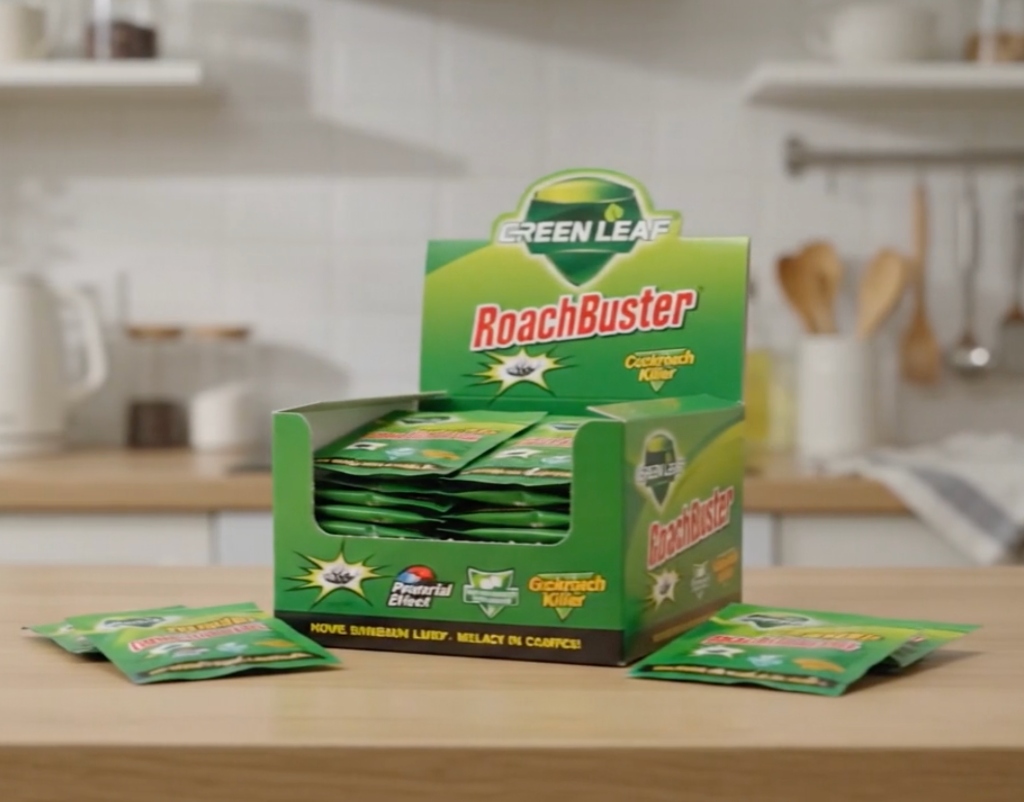
Using RoachBuster for this? If a stall traces back to incomplete coverage, finishing the round properly is what changes the curve. A single box is $47 with 50 odorless, stainless dry powder sachets, free shipping, and a 30-day money-back guarantee. See the box and bundles.
Always use as directed on the product label, and keep placements away from children and pets.
Ten minutes a week is enough to know exactly where you stand.
That last rule matters more than it sounds. Most treatments that fail do so because someone intervened on day four. Fixing decision points to day 14 and day 21 removes the panic response from the process.
You can consider a round complete when all of the following hold for two consecutive weeks: no fresh droppings on any marked patch, no trap catches, no live sightings including after dark with a torch, and no musty smell in previously affected voids. At that point shift from treating to preventing — seal gaps, keep placements at shared-wall penetrations, and keep the water and food discipline. The guide to reinfestation covers the mistakes that undo a finished job.
In the first few days, usually not. Affected insects move more and hide less, so they become visible. A sustained increase after two weeks is a different matter.
Wipe a small marked patch to create a baseline, but do not deep-clean the void or remove the placement. You need the evidence and the treatment in place.
One per treated area is enough, provided you keep them in the same positions. Consistency matters far more than quantity.
Almost never. Day seven is inside the normal window where progress is real but modest. Switching resets the clock and often introduces a repellent that makes things worse.
That usually means the adult population has dropped and you are seeing the hatch cohort. Keep placements active and expect it to resolve over the following two to three weeks.
Judge progress on fresh droppings against a marked baseline, dead insects in the open, and trap catch rate — not on last night’s sighting. Expect nothing for three days, clear movement by day ten, and a second wave around week three. Only make decisions at day 14 and day 21. If it has genuinely stalled, check placement siting and water first, then spray residue, then coverage. Always use as directed on the product label, and keep placements away from children and pets.
Treating an active infestation? One box treats one room, once. The 3-Box Kit — $120 (150 sachets, save $59.97) covers a full apartment through the complete 3-4 week treatment cycle; a $47 single box (50 sachets) covers a single-room problem. Ships within 1 business day, typical delivery 6-10 days · Free tracked shipping · 30-day money-back guarantee.
Choose your kit →

Found roaches tonight? The first 48 hours decide whether your treatment works. Hour one containment, the after-d...
Coverage is about cavities, not square footage. Room-by-room sachet counts, realistic totals for studios through...
Why utility rooms make better cockroach habitat than kitchens, the seven places to inspect around a washer and d...
Your anonymous feedback helps us improve our educational home defense resources.