
Roach Control for Multi-Unit Buildings: A Landlord Treatment Plan
Treating one flat in a connected block fails predictably. How to survey across unit boundaries, quantify a build...

In the professional pest control industry, Alpine WSG is widely considered one of the most effective tools for managing German cockroach infestations. Unlike traditional pesticide sprays that act as strong repellents, Alpine WSG is a non-repellent water-soluble granule. Understanding how to use this professional spray alongside dry powder baits is the key to achieving a roach-free home. Roaches walking past your placements? See the five real reasons in roach bait not working, then compare formats in our best roach killer powder guide.
Alpine WSG’s active ingredient is Dinotefuran, a neonicotinoid that targets the insect’s nervous system. Because it is completely odorless and non-repellent, cockroaches cannot detect it. They crawl over treated baseboards, door frames, and crevices without realizing they are picking up a lethal dose. The chemical clings to their bodies, and they transfer it to other roaches through contact and grooming back in the nesting center.
While Alpine WSG is excellent for covering large surfaces and baseboards, it does not provide an active food attractant. To draw cockroaches out of deep, inaccessible wall voids and appliance motors, you need to pair the spray with a highly appealing food bait. Applying a bait alongside Alpine WSG ensures that roaches are hit from both directions: they pick up the spray through contact on surfaces, and they ingest the bait as a primary food source.
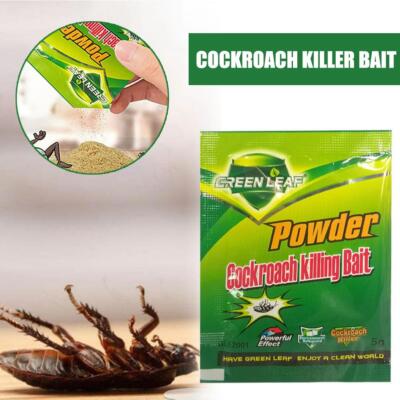
To set up this professional-grade protocol, spray Alpine WSG along baseboards, door entries, and pipe collars. Then, place GreenLeaf RoachBuster dry powder sachets inside cabinets, drawers, and directly behind the refrigerator or stove. Since RoachBuster is a dry, non-repellent borate powder enclosed in paper, it complements Alpine WSG perfectly. The roaches feed on the dry powder inside the cabinets while crossing the non-repellent spray barrier on the floor, resulting in rapid colony collapse.
Next steps: how powder, sprays and foggers differ, how to tell whether a treatment is working, and how many sachets a full round actually takes.
A water-soluble granule, usually abbreviated WSG, is a professional formulation type rather than a chemistry. The product arrives as a dry granule that dissolves in water to make a spray or a surface application, and the format exists because it stores well, measures accurately and produces very little dust or solvent odour compared with older concentrate types. Several professional non-repellent products are supplied this way, and they are typically used by licensed technicians as part of an integrated programme rather than as a standalone consumer purchase.
The important part for a householder is not the brand name but the property that makes such products valuable: non-repellency. That is the characteristic worth understanding, because it determines whether the products in your home work together or against each other.
| Property | Repellent product | Non-repellent product |
|---|---|---|
| Insect response on contact | Avoids the treated surface | No avoidance; normal behaviour continues |
| Effect on aggregation | Disperses it into new locations | Leaves it intact while reducing it |
| Compatibility with bait | Poor; reduces bait acceptance | Good; complements bait |
| Reaches insects in voids | No | Yes, through normal movement and transfer |
| Visible short-term effect | Strong | Limited in week one |
| Outcome over six weeks | Frequent rebound | Sustained decline |
This is why professionals increasingly build programmes from non-repellent components, and why adding a consumer knockdown aerosol to such a programme can undo it. The mechanism is set out in our method comparison and the dispersal problem specifically in our article on why populations return.
Notice that only one of those six steps is the product application. A programme that consists of the application alone is the pattern described in our article on reading whether treatment is working.
Most households do not have access to professional formulations, and in many jurisdictions applying them requires certification. The practical route to the same principle is a consumer non-repellent bait, placed densely at harbourage and along travel routes, kept in position through the hatch window, combined with moisture removal, exclusion work and monitoring. That covers five of the six steps above. The one you cannot replicate is a licensed residual application into voids, which is precisely the situation in which calling a licensed professional is worth the money: persistent activity after two properly executed bait rounds, a multi-unit building with continuous reintroduction, or a commercial premises with compliance obligations.
Availability and licensing requirements vary widely by country and state. Some products are restricted to certified applicators. Check your local rules before purchasing, and be cautious about grey-market suppliers whose labels may not match local approvals.
Not automatically. Placement quality, non-repellency and persistence matter more than the label class. A well-placed consumer bait usually outperforms a poorly placed professional application.
That combination is common in professional programmes. Combining products yourself means reading both labels carefully and confirming they are approved for the same use pattern.
A repellent aerosol or fogger with any bait programme. That single combination undoes more household treatments than anything else.
A water-soluble granule is a format, not a chemistry, and the property worth caring about is non-repellency. Professional programmes layer inspection, a non-repellent core, a growth regulator, exclusion and life-cycle follow-ups; a household can replicate most of that with a consumer non-repellent bait placed densely and kept in position. Never add a repellent aerosol to any of it. One box of fifty sachets gives you the non-repellent core for a whole home, with a 30-day money-back guarantee.
Always use any product as directed on its label, and keep placements out of reach of children and pets. Professional products often carry licensing and certification requirements that vary by jurisdiction; check what applies where you live before buying or applying anything.
Treating an active infestation? One box treats one room, once. The 3-Box Kit — $120 (150 sachets, save $59.97) covers a full apartment through the complete 3-4 week treatment cycle; a $47 single box (50 sachets) covers a single-room problem. Ships within 1 business day, typical delivery 6-10 days · Free tracked shipping · 30-day money-back guarantee.
Choose your kit →

Treating one flat in a connected block fails predictably. How to survey across unit boundaries, quantify a build...
A resurgence at three weeks and a resurgence at three months are different problems. The six causes of reinfesta...

Found roaches tonight? The first 48 hours decide whether your treatment works. Hour one containment, the after-d...
Your anonymous feedback helps us improve our educational home defense resources.