
Roach Control for Multi-Unit Buildings: A Landlord Treatment Plan
Treating one flat in a connected block fails predictably. How to survey across unit boundaries, quantify a build...

In modern commercial office blocks and shared corporate facilities, maintaining clean, pest-free environments is a fundamental business necessity. An active pest infestation in a breakroom or executive kitchen can destroy employee morale, damage corporate reputation, and present health risks. Plan the schedule around our guide to how long roach treatment takes before booking anything.
Office breakrooms are highly vulnerable to cockroach outbreaks. Between microwave compressors, hot water dispensers, coffee makers, and employee food storage cabinets, these spaces offer plenty of warmth and water. Crumbs naturally gather behind recycling bins and under breakroom sinks, creating an ideal habitat.
Spraying corporate workspaces with traditional liquid chemical pesticides is highly disruptive. It requires evacuating staff, shutting down offices, and airing out rooms for hours to clear toxic chemical odors. Additionally, strong chemical smells can cause allergic or respiratory reactions in sensitive staff, creating liabilities.
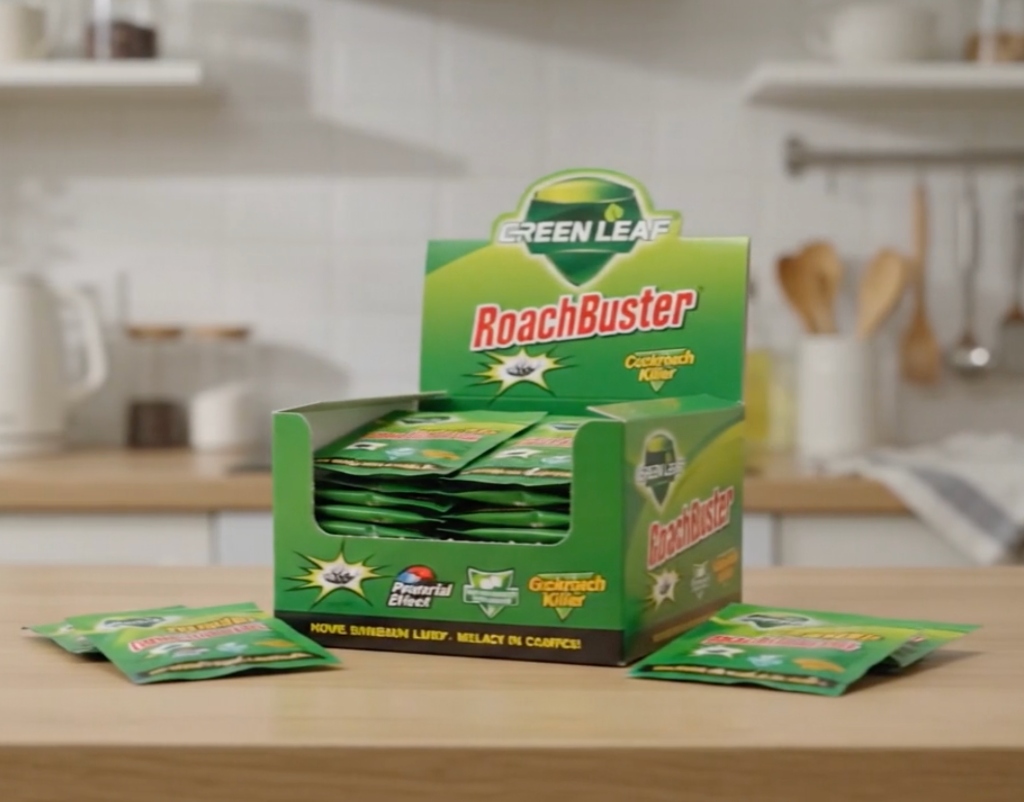
To maintain flawless office sanitation without interrupting daily business operations or enqueuing smelly chemical sprays, the RoachBuster B2B dry sachet system provides an elite commercial alternative:
An office breakroom concentrates every condition a cockroach population needs into ten square metres, and then leaves it unattended for sixteen hours a day. There is a sink with a permanently damp cabinet, a fridge with a warm compressor recess and a condensate tray, a microwave with a food-debris base, a dishwasher or a drying rack, a coffee machine with a grounds drawer, a bin that is emptied on a cleaning schedule rather than immediately, and cupboards holding open packets of biscuits, sugar and instant noodles. It is a functioning kitchen with none of a kitchen kitchen discipline.
The second reason it matters is reputational. Staff and visitors read a single insect sighting in a breakroom as a statement about the whole building. That makes speed and discretion more valuable than raw treatment strength, and it rules out anything that requires closing the room or leaves a smell in an open-plan floor.
Because none of that requires the room to be closed, the treatment is invisible to staff. That is usually the deciding factor for facilities teams, and it is why aerosols and foggers are impractical in occupied commercial space; see our method comparison.
| Position | Placements | Note |
|---|---|---|
| Sink cabinet rear corners | 2 | At pipe penetrations, on a dry surface |
| Fridge compressor recess | 1 to 2 | Rear, clear of the condensate tray |
| Microwave base or shelf rear | 1 | Behind the appliance, not underneath the turntable |
| Dishwasher side gap or plinth kick | 1 to 2 | Dry position |
| Coffee machine base or grounds area | 1 | Rear, out of sight |
| Bin enclosure floor corners | 1 to 2 | Not inside the liner |
| Cupboard floor corners | 2 | Behind stored goods |
| Vending machine recess, if present | 1 to 2 | Rear base |
Acknowledge it to the reporter, action it the same day, and communicate briefly and factually if more than one person saw it. Silence generates more anxiety than a two-line update.
Enclosed dry placements need no exclusion period, so yes. Anything that requires ventilation should be scheduled out of hours.
Roughly ten to fourteen per breakroom plus placements at any shared waste room and any floor with a plumbing riser issue. Use the coverage arithmetic to scale, and our multi-unit plan if the building has several tenancies.
Document it and raise it with the landlord or managing agent in writing. Shared-void reinfestation is common in commercial buildings and is explained in our recurrence guide.
The breakroom is a kitchen without kitchen discipline. Treat the fridge recess, sink cabinet, microwave, dishwasher, coffee station and bin enclosure with enclosed dry placements during business hours, brief the cleaners, log it on a plan, and enforce daily bin emptying and a weekly fridge clear-out. A three-box pack covers several breakrooms for a year of monthly rounds, with a 30-day money-back guarantee.
Always use any bait product as directed on its label, and keep placements out of reach of children and pets.
Maintain uninterrupted operations. Protect breakrooms, coffee stations, and server rooms with the RoachBuster 3-Box commercial Bundle.
Free shipping, secure Stripe checkout, and a 30-day money-back guarantee.
Next steps: the building-wide plan for multi-unit properties, how many sachets a full round actually takes, and how to tell whether a treatment is working.
Treating an active infestation? One box treats one room, once. The 3-Box Kit — $120 (150 sachets, save $59.97) covers a full apartment through the complete 3-4 week treatment cycle; a $47 single box (50 sachets) covers a single-room problem. Ships within 1 business day, typical delivery 6-10 days · Free tracked shipping · 30-day money-back guarantee.
Choose your kit →
Treating one flat in a connected block fails predictably. How to survey across unit boundaries, quantify a build...
Student housing concentrates every risk factor for roaches. What to check on move-in, how to report properly, ho...
How infestations travel on moving day, how to inspect a new home before you sign, packing rules for cardboard an...
Your anonymous feedback helps us improve our educational home defense resources.