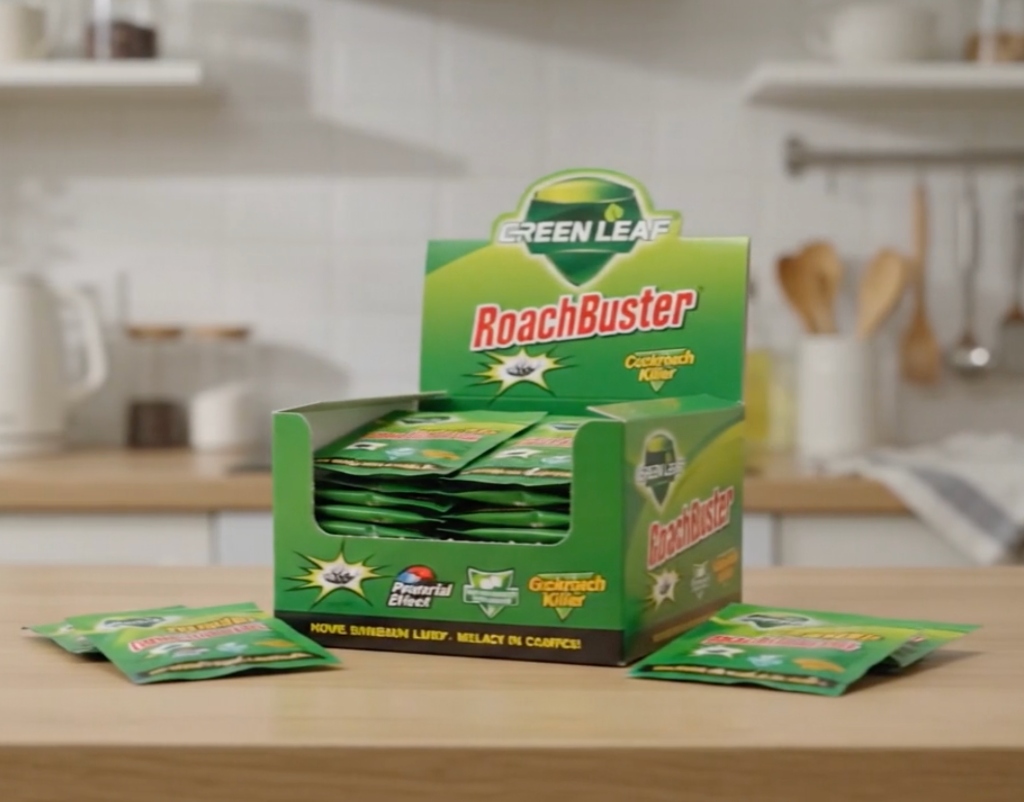
Managing cockroach outbreaks inside daycares, early learning centers, and preschools is subjected to strict government licensing regulations. Tenancy and childcare guidelines heavily restrict the use of chemical liquid spraying or open, sticky gel traps due to pediatric exposure risks. Before placing any product, pet owners should read our guide to pet-safe roach killers for what to buy and what to avoid.
The Strict Childcare Pesticide Regulations
Standard liquid pesticide sprays leave chemical residues on baseboards and carpets where toddlers crawl and play. Fume-heavy sprays also off-gas volatile organic compounds that can trigger severe asthma and respiratory flare-ups in children. Childcare licensing rules mandate strict “low-exposure” pest control solutions.
Hidden Surgical Paper Sachets: The Regulatory-Compliant Solution
To eliminate pest outbreaks safely while meeting strict daycare licensing standards, the **RoachBuster dry sachet system** provides an elite alternative:
- 100% Odorless and Fume-Free: Does not release airborne residues or VOCs, keeping indoor play area air pristine.
- No Runny Mess: Unlike cheap runny gel baits, our dry active powder remains completely enclosed inside paper sachets. It will never run or stain play tables.
- Tamper-Proof Placement: Slim paper sachets slide safely behind heavy wall baseboards, under kitchen kickplates, and inside closed cabinet hinges, keeping active bait entirely inaccessible to children.
Why childcare settings need a different playbook
A licensed childcare facility is judged against two separate standards at once. It has to be demonstrably pest-free, because visible activity is usually a citable finding, and it has to be demonstrably safe, because chemical residue in a room used by infants is equally citable. Those two requirements pull in opposite directions if your only tool is a spray. The way out is a treatment approach whose safety case is about placement and enclosure rather than about timing and ventilation.
In practice that means every placement in a childcare setting must satisfy three tests: it is physically inaccessible to a child, it is documented, and it leaves no residue on any surface a child or a food item touches. If a placement cannot pass all three, it should not be used in that room.
The inaccessibility test, room by room
| Room type | Acceptable positions | Never |
|---|---|---|
| Infant rooms | Inside locked utility cupboards, behind fixed wall units, under fixed cabinetry with no gap access | Floor level, under cots, behind toy storage |
| Toddler rooms | Inside locked storage, behind fixed shelving at height | Anywhere reachable at floor level |
| Nappy change and wet areas | Under-sink cabinets with child locks fitted | Open shelving |
| Kitchen and food prep | Behind and under fixed appliances, inside sink cabinet | On prep surfaces or in food storage |
| Laundry and utility | Behind machines, at wall penetrations | Accessible floor space |
| Corridors and entries | Threshold corners behind door stops | Open floor runs |
| Outdoor play | Not recommended | Anywhere in the play area |
The pattern is consistent: mechanical and utility spaces carry the treatment, and occupied rooms are protected by treating their boundaries rather than their interiors. This is more restrictive than a domestic plan and it works because the insects travel between rooms through those same boundaries.
Documentation an inspector will actually accept
- A site plan marked with every placement position, updated whenever a placement moves.
- A dated log of placement, inspection and replacement, with the initials of the person who did it.
- The product label and safety data sheet held on site, in the same folder.
- A written procedure stating who may place product, where it may not be placed, and what happens if a child accesses a placement.
- A record of the physical exclusion work carried out, since inspectors weigh prevention as heavily as treatment.
- Incident records for any sighting, with the date reported and the date actioned.
Facilities that keep this folder current tend to convert a potential citation into an observation, because the finding becomes evidence of a managed programme rather than of neglect.
Exclusion work that pays for itself in a childcare building
- Door sweeps on every external door and on the kitchen door.
- Sealed pipe penetrations in every sink cabinet, since these are the main inter-room routes.
- Covered floor drains in kitchen and laundry.
- Cardboard eliminated from all storage; food, art supplies and nappies in lidded plastic.
- Nightly removal of food waste to an external bin with a closing lid.
- A no-food policy outside designated eating areas, which is as much a pest control measure as a hygiene one.
Why odourless matters here more than anywhere
Parents notice smell. A chemical odour at drop-off generates questions that no amount of compliance paperwork fully settles, and staff with asthma or chemical sensitivity are common in the sector. A dry, odourless sachet placed inside a locked cupboard produces no odour signal at all, which removes the conversation. Our guide to odourless roach control sets out the options and their limits, and our method comparison explains why aerosols and foggers are a poor fit for occupied childcare space.
Questions childcare operators ask
Can we treat while children are on site?
Placements in locked or enclosed positions can generally be installed outside contact hours and left in place, but you should follow your licensing authority guidance and your product label. Where any doubt exists, place after hours.
What do we do if a child reaches a placement?
Remove it, follow the first-aid guidance on the product label, contact your local poison information service if advised, notify the parent and record the incident. Then review why the position was accessible.
How often should placements be checked?
Weekly visual checks in kitchen and utility areas and a monthly full round is a reasonable baseline for a licensed facility, with everything logged.
Do we still need a licensed contractor?
Many jurisdictions require a licensed operator for commercial premises or for certain product classes. Check locally. In-house preventive placement of a consumer-labelled product is often permitted alongside a contracted programme, but the rules vary and the licence condition wins.
The short version
In a childcare setting, treat boundaries and utility spaces rather than occupied rooms, make every placement physically inaccessible, keep a plan, a log, a label and a written procedure in one folder, and use an odourless product so that parents never smell your pest programme. A five-box case covers a typical facility for a year of monthly rounds, with a 30-day money-back guarantee.
Always use any bait product as directed on its label, and keep placements out of reach of children and pets. This is general operational guidance, not legal or regulatory advice; licensing standards and inspection criteria vary by jurisdiction.
Secure Child Daycares Symmetrically
Meet licensing standards cleanly. Protect early learning centers with the RoachBuster 3-Box commercial Bundle today.
Free shipping, secure Stripe checkout, and a 30-day money-back guarantee.
Next steps: the building-wide plan for multi-unit properties, how many sachets a full round actually takes, and how to tell whether a treatment is working.
Treating an active infestation? One box treats one room, once. The 3-Box Kit — $120 (150 sachets, save $59.97) covers a full apartment through the complete 3-4 week treatment cycle; a $47 single box (50 sachets) covers a single-room problem. Ships within 1 business day, typical delivery 6-10 days · Free tracked shipping · 30-day money-back guarantee.
Choose your kit →