
Roach Control for Multi-Unit Buildings: A Landlord Treatment Plan
Treating one flat in a connected block fails predictably. How to survey across unit boundaries, quantify a build...
Laundry rooms get overlooked because there is no food in them, and that reasoning is exactly why they end up hosting the nest. A utility space combines everything a cockroach colony needs except a pantry: a permanently warm motor housing, a drain and a supply connection that stay damp, dark enclosed cavities behind and beneath two large appliances, and lint, which is fibrous organic material that works as both food and nesting substrate. Finding the harborage is half the job — our guide to finding a roach nest in 48 hours shows exactly where to look first.
This guide covers why laundry rooms are such good habitat, the seven places to inspect, and how to treat around a washer and dryer without putting bait anywhere near clothing or a heat source.
| Requirement | What the laundry room provides |
|---|---|
| Water | Supply hose connections, the drain standpipe, the pump and sump, condensation on cold pipes, and damp lint |
| Heat | The washer motor housing and the dryer drum bearing, motor and exhaust ducting, all warm for hours after a cycle |
| Harbourage | The cavity behind and under both machines, the frame channels, the pedestal void, and the gap behind the standpipe |
| Food | Lint, fabric fibres, detergent residue, food soil rinsed out of clothing, and spilled powder |
| Quiet | Most utility rooms go undisturbed for days at a time, which is exactly what a colony needs |
A kitchen has more food but far more disturbance. A laundry room has slightly less food and almost no disturbance, and for a breeding colony that trade is favourable.
If you find droppings in more than one of these positions, treat the room as a primary nest site rather than a secondary zone. Identifying the evidence correctly matters here because lint and detergent granules are easy to confuse with droppings; the differences are covered in our guide to nesting signs.
Lint deserves its own section because it is the reason laundry rooms sustain populations that would starve elsewhere. It is dry, fibrous, warm, and it accumulates in exactly the enclosed cavities a colony wants. It also holds enough organic residue from clothing to serve as a food source, and it provides the multi-surface contact cockroaches seek. Clearing lint from beneath and behind the machines, not just from the trap, removes shelter and food in one action.
There is a second reason to do it: lint accumulation in a dryer duct is a fire risk independent of any pest issue, so this is one maintenance task that pays for itself twice.
Placement in a laundry room has constraints a kitchen does not, mainly heat, vibration, and clothing. Work through these rules rather than treating it as another cabinet.
Two specific reasons on top of the usual ones. First, an aerosol in a small room with a gas dryer or a pilot flame is an obvious hazard, and residue on a hot dryer casing is not something you want in the air. Second, repellent residue near clothing and towels is the last place you want it. A non-repellent dry bait placed in the cavities behind the machines addresses the nest without putting anything on fabric or into the air. The broader case against repellents is in why sprays make roaches scatter.
A shared laundry room in a building is a different problem, because it functions as a distribution hub. Every resident carries baskets in and out, the machines run warm almost continuously, and no single tenant is responsible for the cavity behind them. If your building has one and you have activity in your unit, assume the shared room is a candidate source and raise it with the building manager in writing rather than treating your own flat repeatedly.
They do not live in the drum, which is regularly flooded, but they readily occupy the surrounding cabinet: the motor and pump housing underneath, the frame channels, and the space behind the rear panel. Those areas stay warm and slightly damp and are never disturbed.
A hot wash and a full hot tumble dry will deal with insects and eggs on fabric, and it is worth doing for anything stored in an affected room. It does nothing about the nest in the appliance cavity, which is where the population actually lives.
Yes, if the exterior damper is broken, propped open by lint, or missing. It is a warm, sheltered opening leading directly into a lint-filled duct, which is an attractive route. Checking and repairing the hood is one of the higher-value fixes in the room.
Usually because that is where the harbourage and moisture are, and the kitchen simply provides feeding trips. If sightings are concentrated in one room, three nights of glue boards will confirm whether it is the nest or a corridor. The method is in mapping a nest with sticky traps.
Laundry rooms reward this work more than most spaces, because the harbourage is concentrated in a few accessible cavities and the moisture problems are usually easy to fix. Pull the machines out once, vacuum thoroughly, seal the standpipe, repair the vent hood, and place dry bait in the cavities behind them.
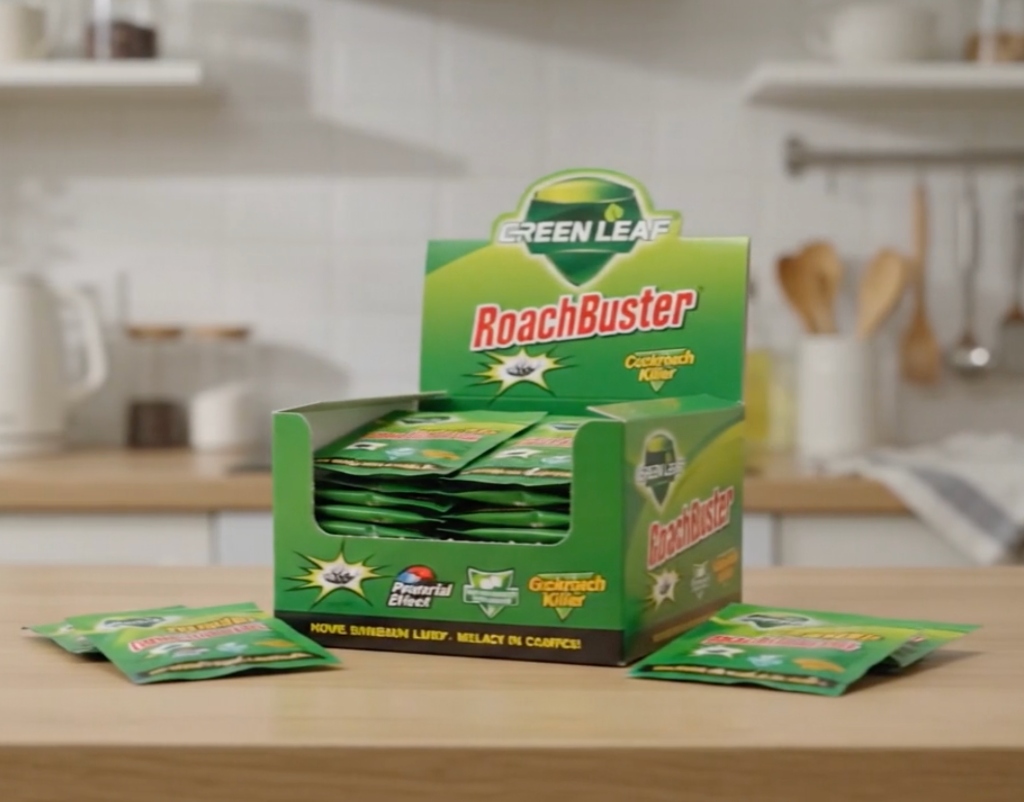
For placement in a warm, humid room, GreenLeaf RoachBuster works well because the sachets are dry, odorless and non-staining, so there is nothing to run or dry out and nothing to mark towels and clothing. A single 50-sachet box covers a utility room and the kitchen alongside it. Always use as directed on the product label, and keep placements away from children and pets.
Wider reading: the complete Roach Control Guide maps every article on the site by the question you are trying to answer — first 48 hours, identification, method, room by room, comparisons, safety, rentals and local conditions.
Claim the 50-sachet GreenLeaf RoachBuster box today. Free shipping, secure Stripe checkout, a 30-day money-back guarantee, and targeted odorless dry powder sachets built for kitchens, cabinets, gaps and appliances.
Use only as directed on the product label. Keep away from children and pets.
Treating an active infestation? One box treats one room, once. The 3-Box Kit — $120 (150 sachets, save $59.97) covers a full apartment through the complete 3-4 week treatment cycle; a $47 single box (50 sachets) covers a single-room problem. Ships within 1 business day, typical delivery 6-10 days · Free tracked shipping · 30-day money-back guarantee.
Choose your kit →

Treating one flat in a connected block fails predictably. How to survey across unit boundaries, quantify a build...
A resurgence at three weeks and a resurgence at three months are different problems. The six causes of reinfesta...

Found roaches tonight? The first 48 hours decide whether your treatment works. Hour one containment, the after-d...
Your anonymous feedback helps us improve our educational home defense resources.