Laundry rooms get overlooked because there is no food in them, and that reasoning is exactly why they end up hosting the nest. A utility space combines everything a cockroach colony needs except a pantry: a permanently warm motor housing, a drain and a supply connection that stay damp, dark enclosed cavities behind and beneath two large appliances, and lint, which is fibrous organic material that works as both food and nesting substrate. Finding the harborage is half the job — our guide to finding a roach nest in 48 hours shows exactly where to look first.
This guide covers why laundry rooms are such good habitat, the seven places to inspect, and how to treat around a washer and dryer without putting bait anywhere near clothing or a heat source.
Why a laundry room beats a kitchen
| Requirement | What the laundry room provides |
|---|---|
| Water | Supply hose connections, the drain standpipe, the pump and sump, condensation on cold pipes, and damp lint |
| Heat | The washer motor housing and the dryer drum bearing, motor and exhaust ducting, all warm for hours after a cycle |
| Harbourage | The cavity behind and under both machines, the frame channels, the pedestal void, and the gap behind the standpipe |
| Food | Lint, fabric fibres, detergent residue, food soil rinsed out of clothing, and spilled powder |
| Quiet | Most utility rooms go undisturbed for days at a time, which is exactly what a colony needs |
A kitchen has more food but far more disturbance. A laundry room has slightly less food and almost no disturbance, and for a breeding colony that trade is favourable.
The seven places to inspect
- The washer motor and pump housing. Underneath at the rear, warm after every cycle and usually slightly damp. This is the most common nest position in the room.
- Behind and under the dryer. Check the drum bearing area, the motor housing, and the lint that accumulates beneath the machine rather than in the trap.
- The exhaust duct and vent hood. Flexible ducting collects lint along its whole length, and the exterior hood flap is a genuine entry point from outside if the damper is broken or stuck open.
- The drain standpipe and the gap around it. The annular gap where the pipe passes through the floor or wall is both a harbourage crevice and a direct route to the waste stack.
- Supply hose connections and the shut-off valves. Slow weeps here are common and often invisible because the water evaporates on a warm pipe.
- Pedestals, plinths and the void beneath a stacked unit. These are enclosed on five sides and never cleaned.
- Shelving and stored items. Cardboard boxes of detergent, paper towel packs, and stored bags provide harbourage. Cardboard on a shelf above a warm machine is close to ideal.
If you find droppings in more than one of these positions, treat the room as a primary nest site rather than a secondary zone. Identifying the evidence correctly matters here because lint and detergent granules are easy to confuse with droppings; the differences are covered in our guide to nesting signs.
The lint problem
Lint deserves its own section because it is the reason laundry rooms sustain populations that would starve elsewhere. It is dry, fibrous, warm, and it accumulates in exactly the enclosed cavities a colony wants. It also holds enough organic residue from clothing to serve as a food source, and it provides the multi-surface contact cockroaches seek. Clearing lint from beneath and behind the machines, not just from the trap, removes shelter and food in one action.
There is a second reason to do it: lint accumulation in a dryer duct is a fire risk independent of any pest issue, so this is one maintenance task that pays for itself twice.
The clear-out, step by step
- Pull both machines forward. You need access to the rear and the floor beneath. Take a photo of the hose and duct positions first so reassembly is straightforward.
- Vacuum everything. The floor cavity, the rear panels, the motor housings, the frame channels, and the full length of the flexible duct. Use a crevice tool and take your time.
- Dispose of the vacuum contents outside immediately, in a sealed bag. Lint and debris from a nest area may contain egg capsules, and a capsule left in a vacuum in the same room will simply hatch there. See how to identify and destroy egg cases.
- Fix every moisture point. Tighten or replace weeping hose connections, check the pump filter, and confirm the standpipe is not backing up. Dry the floor completely.
- Seal the standpipe gap and any pipe penetrations. This closes both a harbourage crevice and a travel route in one go. Our sealing checklist covers suitable approaches.
- Check the exterior vent hood. A damper that no longer closes is an open door. Fit a working hood or a fine mesh guard that does not restrict airflow.
- Remove cardboard and repackage supplies into rigid sealed containers on wipeable shelving.
- Improve ventilation. Leave the washer door ajar between cycles so the drum and seal dry, and run an extractor or open a window if the room holds humidity.
Where to place bait around a washer and dryer
Placement in a laundry room has constraints a kitchen does not, mainly heat, vibration, and clothing. Work through these rules rather than treating it as another cabinet.
- Place along the wall behind each machine, at floor level, where the harbourage actually is.
- Place in the corners of the floor cavity beneath the machines, pushed to the rear.
- Place beside the standpipe, on the dry side, and beside the shut-off valves.
- Place inside the base of a pedestal or plinth void if it is accessible.
- Keep placements off any hot surface: not on the dryer casing, not against the motor housing, and not inside or near the exhaust duct.
- Keep placements away from vibrating panels where they will be shaken out of position each cycle.
- Keep placements well away from laundry baskets, folded clothing, and anywhere a basket is set down.
- Keep placements out of reach of children and pets. Utility rooms often double as pet feeding areas, so move the bowls out or choose positions behind the machines only.
- Follow the product label, and use dry rather than liquid or gel formats here. A humid room dries gels out quickly and a spilled gel on clothing is a stain problem; the difference is covered in gel versus dry powder.
Do not spray a laundry room
Two specific reasons on top of the usual ones. First, an aerosol in a small room with a gas dryer or a pilot flame is an obvious hazard, and residue on a hot dryer casing is not something you want in the air. Second, repellent residue near clothing and towels is the last place you want it. A non-repellent dry bait placed in the cavities behind the machines addresses the nest without putting anything on fabric or into the air. The broader case against repellents is in why sprays make roaches scatter.
Apartment laundry rooms and shared facilities
A shared laundry room in a building is a different problem, because it functions as a distribution hub. Every resident carries baskets in and out, the machines run warm almost continuously, and no single tenant is responsible for the cavity behind them. If your building has one and you have activity in your unit, assume the shared room is a candidate source and raise it with the building manager in writing rather than treating your own flat repeatedly.
- Do not set laundry baskets on the floor in a shared room. Use a table or the top of a machine.
- Do not leave clothing in a machine or on a folding surface for extended periods.
- Check the base of a basket before carrying it back into your unit.
- Wash and dry on the hottest setting the fabric allows, then bag items straight from the dryer if your building has a known problem.
- Keep your own unit protected with maintenance placements, as set out in the apartment strategy.
Frequently asked questions
Can roaches live inside a washing machine?
They do not live in the drum, which is regularly flooded, but they readily occupy the surrounding cabinet: the motor and pump housing underneath, the frame channels, and the space behind the rear panel. Those areas stay warm and slightly damp and are never disturbed.
Will hot washing kill roaches in clothing?
A hot wash and a full hot tumble dry will deal with insects and eggs on fabric, and it is worth doing for anything stored in an affected room. It does nothing about the nest in the appliance cavity, which is where the population actually lives.
Can they come in through the dryer vent?
Yes, if the exterior damper is broken, propped open by lint, or missing. It is a warm, sheltered opening leading directly into a lint-filled duct, which is an attractive route. Checking and repairing the hood is one of the higher-value fixes in the room.
Why do I only see them in the utility room?
Usually because that is where the harbourage and moisture are, and the kitchen simply provides feeding trips. If sightings are concentrated in one room, three nights of glue boards will confirm whether it is the nest or a corridor. The method is in mapping a nest with sticky traps.
Treat the room, not the sighting
Laundry rooms reward this work more than most spaces, because the harbourage is concentrated in a few accessible cavities and the moisture problems are usually easy to fix. Pull the machines out once, vacuum thoroughly, seal the standpipe, repair the vent hood, and place dry bait in the cavities behind them.
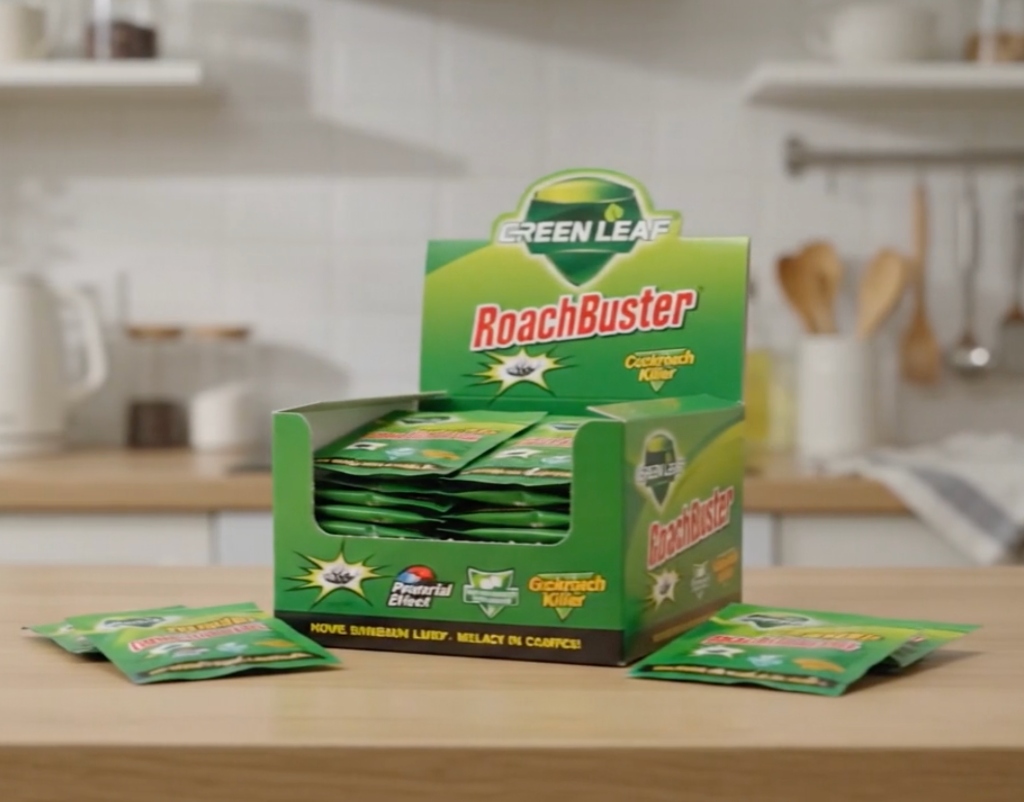
For placement in a warm, humid room, GreenLeaf RoachBuster works well because the sachets are dry, odorless and non-staining, so there is nothing to run or dry out and nothing to mark towels and clothing. A single 50-sachet box covers a utility room and the kitchen alongside it. Always use as directed on the product label, and keep placements away from children and pets.
Wider reading: the complete Roach Control Guide maps every article on the site by the question you are trying to answer — first 48 hours, identification, method, room by room, comparisons, safety, rentals and local conditions.
Ready to clear your home without odors or stains?
Claim the 50-sachet GreenLeaf RoachBuster box today. Free shipping, secure Stripe checkout, a 30-day money-back guarantee, and targeted odorless dry powder sachets built for kitchens, cabinets, gaps and appliances.
Use only as directed on the product label. Keep away from children and pets.
Treating an active infestation? One box treats one room, once. The 3-Box Kit — $120 (150 sachets, save $59.97) covers a full apartment through the complete 3-4 week treatment cycle; a $47 single box (50 sachets) covers a single-room problem. Ships within 1 business day, typical delivery 6-10 days · Free tracked shipping · 30-day money-back guarantee.
Choose your kit →