
Roach Control for Multi-Unit Buildings: A Landlord Treatment Plan
Treating one flat in a connected block fails predictably. How to survey across unit boundaries, quantify a build...

No matter how clean you keep your home, you can still face a cockroach problem if your neighbors have an active infestation. Roaches travel through shared wall voids, pipe chases, and baseboard gaps, constantly seeking new food sources. To protect your home, you must establish an effective perimeter barrier that stops migrating pests in their tracks. If a product you already placed is being ignored, our guide to why roach bait stops working covers the five usual causes and the fix.
The first line of defense is sealing the physical gaps that connect your living space to the building’s infrastructure. Use silicone caulk to seal cracks along baseboards, countertops, and backsplashes. Pay special attention to the voids around utility pipes under your kitchen and bathroom sinks. Wrapping steel wool or wire mesh around pipes before caulking prevents pests from chewing through the barrier.
Many homeowners rely on barrier sprays like Ortho Home Defense along baseboards and doors. While these sprays can deter some pests, they can also cause cockroaches to scatter into wall voids. A cleaner, more effective approach is setting up a non-repellent interception zone. Placing dry powder baits right next to key entry points ensures that any migrating pests eat the bait and die before they can establish a new nesting center in your home.
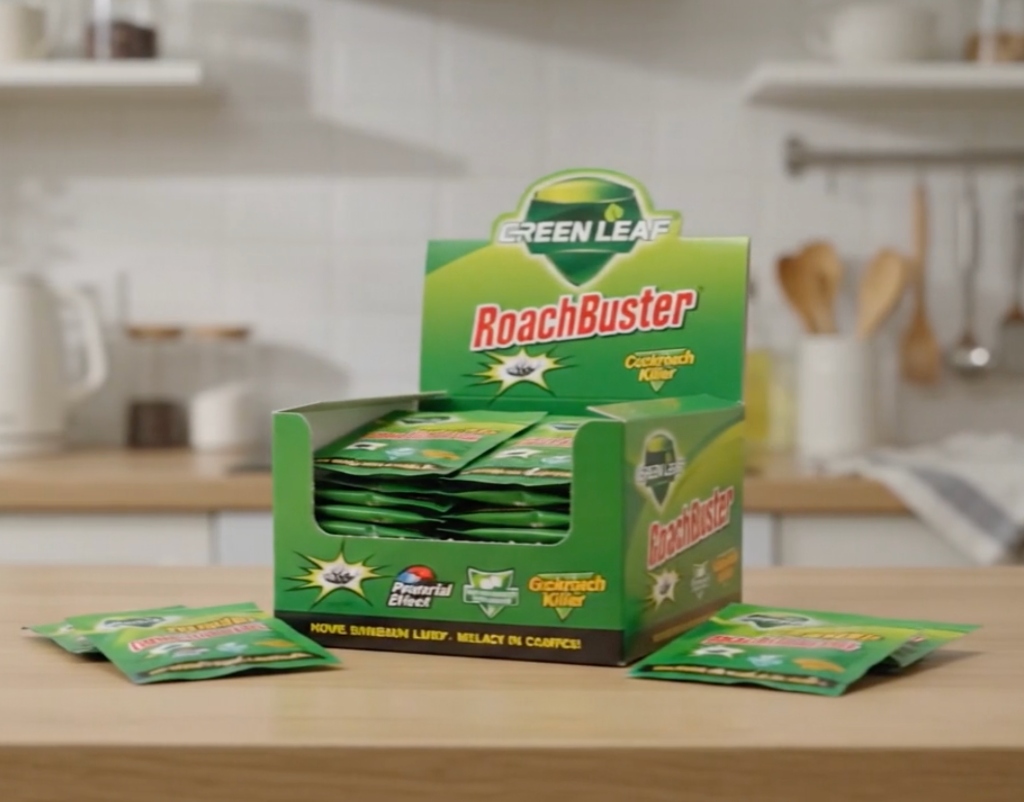
GreenLeaf RoachBuster sachets are the ideal tool for intercepting migrating roaches. Place these odorless, dry sachets directly under sinks, behind the refrigerator, and inside cabinets next to shared walls. Foraging roaches entering from neighboring units are drawn to the sachets, feed on the active dry powder, and carry it back to their nests inside the walls, destroying the colony before it ever reaches your living space.
Next steps: how many sachets a full round actually takes, how to tell whether a treatment is working, and how powder, sprays and foggers differ.
The word barrier normally implies something insects cannot cross. That is not what a bait line is, and understanding the difference is what makes it work. A repellent chemical barrier tries to stop insects crossing a line, and it fails in two ways: the chemistry degrades, and the insects simply find another route, usually one you had not thought of. A bait line does the opposite. It lets insects cross, and it makes crossing costly. Every insect that traverses the boundary encounters a food source, carries material back into the harbourage on the other side, and contributes to reducing the population at the source rather than at your wall.
That is why a bait line is placed on the traffic route rather than across the whole boundary, and why gaps in the line do not defeat it the way gaps in a chemical barrier do.
| Boundary type | Placement positions | Count |
|---|---|---|
| Shared wall, kitchen side | At each pipe penetration, at socket boxes, in cabinet floor corners | 3 to 5 |
| Shared wall, bathroom side | Vanity rear corners, bath panel void, skirting corners | 2 to 4 |
| Entry door from corridor | Both threshold corners, behind the door stop | 1 to 2 |
| Riser or service cupboard | Floor corners and at each penetration | 2 to 3 |
| Adjoining garage or utility | Threshold corners and at the wall junction | 2 to 3 |
| Floor or ceiling void access | At the hatch or panel edge | 1 to 2 |
| Exterior door thresholds | Interior corners | 1 per door |
Twelve to twenty placements builds a complete boundary line for a typical attached home or apartment, and it should be layered rather than single-file: a line at the boundary, and a second set inside the cabinet and appliance cavities where any population that got through will settle. Counts by room are in our coverage arithmetic guide.
Adding a repellent spray to a bait line is self-defeating and it is the most common mistake people make once they understand the concept. The spray drives insects away from the exact positions where your bait is waiting, so uptake collapses, and it pushes traffic onto routes you have not identified. You end up with a treated boundary that nothing crosses and an untreated route that everything uses. If you want the mechanism in detail, our comparison of powder, spray and fogger explains why non-repellent and repellent products cannot be combined usefully in the same space.
Expect noticeable reduction within two weeks and a substantially quiet unit by weeks four to six, assuming the source population on the other side is large. Progress signals are in our is it working guide.
No, and that is its advantage. It needs to intersect the routes insects actually use, which is why the monitoring step matters more than the number of placements.
Yes. That is exactly the situation it is designed for, such as an apartment where the neighbouring unit is untreated. It will not clear the source, but it substantially reduces what reaches you and it contributes to reducing the source population over time.
Both walls, weighted to the kitchen and bathroom ends, plus the floor and ceiling void access points. Two boundaries roughly doubles the placement count.
A bait line is not a wall, it is a toll. Find the smear marks and use overnight monitors to locate real crossings, place twelve to twenty sachets on those routes plus a second layer in cabinet and appliance cavities, inspect monthly, never add a repellent spray, and keep the line in place after activity stops. One box of fifty sachets builds and maintains a full boundary line for a year, with a 30-day money-back guarantee.
Always use any bait product as directed on its label, and keep placements out of reach of children and pets.
Treating an active infestation? One box treats one room, once. The 3-Box Kit — $120 (150 sachets, save $59.97) covers a full apartment through the complete 3-4 week treatment cycle; a $47 single box (50 sachets) covers a single-room problem. Ships within 1 business day, typical delivery 6-10 days · Free tracked shipping · 30-day money-back guarantee.
Choose your kit →

Treating one flat in a connected block fails predictably. How to survey across unit boundaries, quantify a build...
Student housing concentrates every risk factor for roaches. What to check on move-in, how to report properly, ho...

How infestations travel on moving day, how to inspect a new home before you sign, packing rules for cardboard an...
Your anonymous feedback helps us improve our educational home defense resources.