
Odorless Roach Control: What to Use When Sprays Are Off the Table
Asthma, a newborn, a shared ventilation system or a tenancy clause can rule out aerosols entirely. The no-odour ...

When cockroaches invade your home, your first instinct is to get rid of them as quickly as possible. However, if you share your living space with curious dogs or cats, you might worry about the health risks of standard pesticide treatments. Fortunately, you do not have to choose between a pest-free kitchen and the safety of your pets. If there are cats or dogs in the home, our pet-safe roach killer guide walks through which product formats are safe to use around them.
Standard liquid baseboard sprays contain synthetic chemicals that remain wet and accessible on floors for hours. If a dog or cat licks a treated surface, they can ingest the pesticide. Similarly, puffing loose boric acid powder or diatomaceous earth directly onto floors is risky. Pets can walk through the dust, getting it on their paws, and ingest it during grooming, which can cause severe vomiting, diarrhea, or respiratory irritation.
Boric acid is relatively low in toxicity compared to synthetic organophosphates, but it is not harmless. Ingesting large quantities can cause stomach distress. The key to using borate-based treatments safely around pets is secure, targeted application. If the powder is completely enclosed and placed where dogs and cats cannot reach, the risk drops to zero.
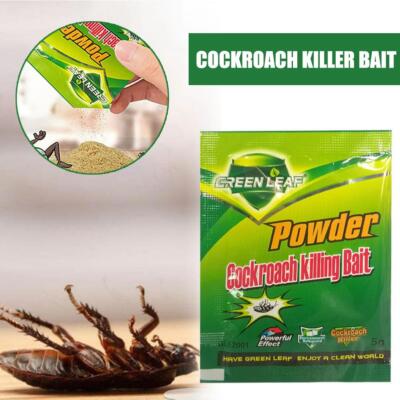
GreenLeaf RoachBuster solves the pet-safety dilemma by enclosing its dry powder bait inside sturdy paper sachets. Instead of dusting open surfaces, you simply place these small sachets in inaccessible voids: deep under cabinets, behind heavy appliances, or inside locked drawers. Cockroaches chew through the paper to feed, while your pets remain completely protected from contacting or inhaling the active ingredients, keeping your home pest-free and your animals safe.
Next steps: odour-free options when sprays are off the table, how many sachets a full round actually takes, and how to tell whether a treatment is working.
Pet safety advice usually treats all animals as one category, which hides the fact that the realistic exposure route is completely different for each species. Getting this right lets you place effectively rather than avoiding whole rooms unnecessarily.
| Animal | Main exposure route | Placement implication |
|---|---|---|
| Dog | Nosing out and chewing floor-level items | Enclosed cavities behind catches; block gaps under 60 mm |
| Cat | Walking on surfaces then grooming paws and fur | No open surface residue; avoid high positions entirely |
| Rabbit or guinea pig, free roaming | Chewing anything at floor level | Treat only rooms the animal cannot access |
| Ferret | Actively entering small cavities | Avoid cavity placements in accessible rooms altogether |
| Bird | Airborne exposure, extremely sensitive | Nothing that aerosolises anywhere in the home |
| Fish or reptile in a tank | Waterborne and airborne via air pump intake | No aerosols; keep placements away from the tank and pump |
| Small caged rodent | Bedding and cage floor contamination | Keep placements out of the room, or well clear and enclosed |
Three inexpensive items do almost all of the work. Magnetic or push child locks on under-sink and low cabinet doors, which stop a determined dog as effectively as a toddler. Plinth strips or foam gap blockers for the sides of the fridge and dishwasher, so that a nose cannot get in. And a placement card taped inside a cupboard door listing every position, so that everyone in the household, including cleaners and visitors, knows what exists and does not relocate it. Total cost is minimal and it converts a household from cautious avoidance to confident treatment. If you want the placement-position detail, our coverage arithmetic guide gives the counts and our odourless control guide covers why enclosed dry formats suit animal households better than sprays and open dusts.
No product is safe to eat. Safety in a household comes from the combination of the formulation, the enclosure and the placement position, and from following the label. Judge products on whether they let you control reach and residue.
Yes, but restrict yourself to fully enclosed positions behind working catches, and consider treating only rooms the animals cannot access unsupervised until they are older.
Fit locks, and if the dog defeats them, move treatment to rooms with closable doors. Some dogs genuinely require the room-exclusion approach.
With enclosed dry placements no exclusion period is normally needed if positions are out of reach and the label is followed. Foggers and sprays are the opposite case and require removing animals entirely.
Match your plan to the species: dogs need floor-level cavities blocked, cats need zero open residue, birds and fish rule out aerosols entirely. Use enclosed positions behind child locks, keep a metre clear of bowls and beds, write a placement card, and know your vet and poison line numbers before you need them. One box provides enough sachets to treat a whole home from enclosed positions, backed by a 30-day money-back guarantee.
Always use any bait product as directed on its label, and keep placements out of reach of children and pets. This is general guidance and not veterinary advice; if you think an animal has ingested any pest control product, contact your vet or an animal poison line immediately.
Treating an active infestation? One box treats one room, once. The 3-Box Kit — $120 (150 sachets, save $59.97) covers a full apartment through the complete 3-4 week treatment cycle; a $47 single box (50 sachets) covers a single-room problem. Ships within 1 business day, typical delivery 6-10 days · Free tracked shipping · 30-day money-back guarantee.
Choose your kit →
Asthma, a newborn, a shared ventilation system or a tenancy clause can rule out aerosols entirely. The no-odour ...
Toxicity depends on the product, the amount and the animal, so the useful question is how to reduce the dose tha...
Borates are odourless because they are not volatile, which also removes the airborne exposure route and the vent...
Your anonymous feedback helps us improve our educational home defense resources.