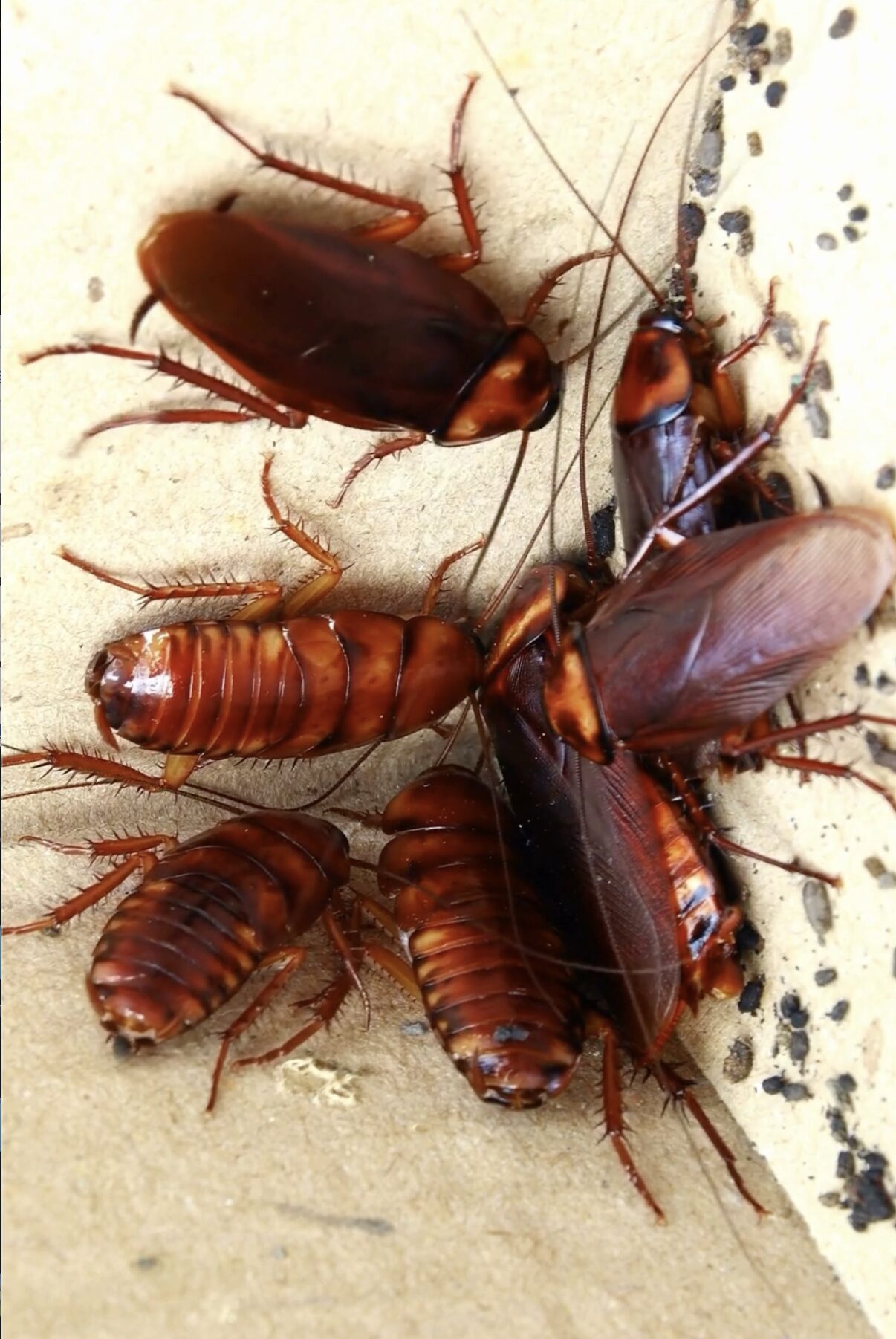
Droppings are the most useful evidence in roach control, because unlike a sighting they tell you where the insects live rather than where they happened to be walking. They also tell you which species you have, roughly how large the population is, and whether the activity is current or historical. Learning to read them properly is worth more than any product decision you will make. For the full clearance sequence after identification, follow the 21-day German roach infestation treatment plan.
This guide covers how to tell droppings from lookalikes, what each pattern indicates, and how to clean them up without spreading allergen-laden dust around your home.
What they look like, by species
| Species | Dropping appearance | Where you will find them |
|---|---|---|
| German cockroach | Tiny dark specks, like coarse ground pepper or ground coffee, under 1 mm, often with dark smear marks alongside | Cabinet corners, hinge recesses, drawer undersides, appliance cavities |
| American cockroach | Larger cylindrical pellets, 2 mm or more, blunt at both ends with visible ridges along the sides | Basements, drains, utility rooms, behind large appliances |
| Oriental cockroach | Similar to American but slightly smaller and often in damp locations | Drains, basements, under sinks, crawl spaces |
| Brown-banded cockroach | Very small specks, often found high up rather than at floor level | Ceiling corners, picture frame backs, inside electronics, upper cabinets |
The distinction that matters most is size and shape. Small specks mean a German cockroach population, which is the species that builds large indoor colonies and needs a sustained baiting approach. Larger ridged pellets point to American or Oriental cockroaches, which usually indicates a drain, sewer, or exterior entry route and a different plan. Our comparison of German and American cockroaches sets out why the treatment differs.
Ruling out the lookalikes
Most people who think they have found droppings have found something else, and most people who have droppings mistake them for dirt. Work through these.
- Mouse droppings are much larger, 3 to 6 mm, tapered at the ends, and often found in a scattered trail along a wall rather than concentrated in a corner.
- Coffee grounds are irregular in shape and size and smell like coffee. Cockroach droppings are uniform and have no coffee aroma.
- Black pepper is the closest visual match, which is why the comparison is standard. Pepper is usually only found where pepper is used, not inside a hinge recess.
- Dried soil and dust smear grey or brown when wiped. Droppings tend to stay as discrete particles and often leave a dark brown streak.
- Ant frass and sawdust are pale and fibrous rather than dark and granular.
- Silverfish and beetle droppings are much finer, closer to a dust, and are usually found in stored paper or dry goods rather than in warm cavities.
A simple test helps. Place a small piece of white paper under the area and gently tap the surface. Droppings fall as distinct dark grains and are easy to assess against the white background.
Reading the evidence
Location tells you where the nest is
Droppings accumulate where insects rest, not where they forage, so concentration is a direct pointer to harbourage. A dozen specks in a hinge recess means the nest is inside that cabinet carcass. Droppings scattered thinly across a shelf usually mean a travel route rather than a nest. Treat the concentration, not the scatter.
Smear marks mean moisture and heavy activity
In humid conditions droppings and secretions produce dark irregular streaks along edges and on vertical surfaces. Smear marks indicate a well-established population in a damp area, and they are worth taking more seriously than dry specks alone.
Quantity gives you a rough scale
- A few specks in one location: low-level or recent activity, possibly a single introduced insect.
- A visible dusting in several cabinet corners: an established population, likely several weeks or months old.
- Accumulations you can see from a standing position, plus shed skins and egg capsules: a substantial multi-generation population.
- Droppings in more than one room: the population has outgrown a single harbourage zone.
Fresh versus old
This is the test that decides whether you still have a problem. Fresh droppings are dark, sit loosely on the surface, and smear if pressed. Old droppings are lighter, dry, and often adhered in place. The reliable method is to clean an area completely, note the date, and re-check in seven days. Anything new in a cleaned area means live insects, and no new material after two weeks is one of the better confirmations that a treatment worked. Combine it with monitors, as described in mapping activity with sticky traps.
Look for what sits alongside them
Droppings rarely appear alone. Shed skins, which are pale, hollow and often translucent, indicate nymphs developing on site. Egg capsules indicate active breeding, and finding them changes your timeline; see our guide to egg cases. A musty odour alongside droppings indicates a heavier population, discussed in eliminating the musty smell.
Cleaning up safely
This part matters more than people assume. Cockroach droppings and shed skin fragments contain proteins that are a recognised indoor allergen and a documented asthma trigger, particularly for children. The practical consequence is that you should avoid any method that turns settled material into airborne dust.
- Wear disposable gloves and a fitted dust mask. Simple, and the single most useful precaution.
- Do not dry sweep or dry brush. Sweeping is the most effective way to put allergenic particles into the air you are standing in.
- Do not use compressed air or a leaf blower to clear an appliance cavity, for the same reason.
- Vacuum first, with a HEPA filter or sealed bag. A standard vacuum without adequate filtration can exhaust fine particles back into the room.
- Then wipe with warm water and detergent. Detergent is what actually removes the residue. Wipe in one direction with a disposable cloth rather than rubbing material around.
- Dispose of gloves, cloths and the vacuum bag or canister contents in a sealed plastic bag, outside, immediately. Egg capsules can survive in vacuum debris.
- Ventilate the room while you work and for a while afterwards.
- Wash any fabric or utensils that were in the affected area on the hottest setting appropriate for the material.
- Do not use bleach in a confined cavity and never mix cleaning products. Warm detergent solution is sufficient and safer.
Why you should clean, and why you should not clean everything
There is a genuine tension here, and it is the mistake most people make once they start finding evidence. Cleaning removes allergens, removes food, and gives you a baseline for measuring whether activity is current, all of which is valuable. But cleaning the areas where you have placed bait, or scrubbing out a harbourage zone mid-treatment, undoes the treatment and pushes the colony to relocate.
The way to resolve it is sequencing. Clean thoroughly first, establish your baseline, then place bait and leave those specific placements and their immediate surroundings alone for several weeks. Clean the rest of the home normally. The full sequence and what to expect week by week is in our treatment timeline.
Where to look if you have found nothing yet
- Pull the lowest kitchen drawer fully out and inspect its underside and the carcass behind it.
- Open every cabinet hinge recess and look into the cam-lock holes.
- Look at the back corner under the sink, around the plumbing collar.
- Pull the refrigerator out and check the compressor housing and drip pan.
- Check the microwave control panel cavity and vent slots.
- Inspect the underside of shelves rather than the tops.
- Look behind the kick board or plinth at the base of the units.
- Check the bathroom vanity interior and behind the toilet base.
- For brown-banded cockroaches, check high: ceiling corners, curtain rod ends, and the inside of electronics housings.
The kitchen cabinet audit works through the kitchen systematically if you want a full pass rather than spot checks.
Frequently asked questions
Are cockroach droppings dangerous?
The main recognised concern is allergen exposure. Proteins in droppings and shed skins are an established indoor allergen and asthma trigger, especially for children, and droppings can also carry bacteria picked up from drains and waste. Handle them with gloves and a mask, avoid creating dust, and wash surfaces with detergent. Our article on the health risks of an infestation covers this in more detail.
How can I tell if droppings are old or new?
Clean the area completely, note the date, and check again in seven days. New material means live activity. This is far more reliable than judging colour or texture.
Do droppings attract more roaches?
Droppings carry aggregation cues that make a location more attractive to other individuals, which is one of the reasons a cleaned site still gets reoccupied unless the harbourage is treated. Removing the residue reduces that signal.
Can I just vacuum them and be done?
Vacuuming removes the material but not the population, and droppings in a hinge recess mean insects living inside the carcass behind it. Treat vacuuming as cleanup and diagnosis rather than control, and place bait in the harbourage you have just identified.
Let the evidence choose the placements
Droppings are the closest thing to a map you will get for free. Identify the species from their size and shape, treat the concentrations as harbourage rather than mess, clean safely with a vacuum and detergent rather than a brush, and then put bait exactly where the evidence was densest.
For that step, GreenLeaf RoachBuster provides 50 odorless, stainless dry powder sachets per box, enough to place several small stations in every location where you found droppings, without a scent or residue that would drive the colony to relocate. Always use as directed on the product label, and keep placements away from children and pets.
Wider reading: the complete Roach Control Guide maps every article on the site by the question you are trying to answer — first 48 hours, identification, method, room by room, comparisons, safety, rentals and local conditions.
Ready to clear your home without odors or stains?
Claim the 50-sachet GreenLeaf RoachBuster box today. Free shipping, secure Stripe checkout, a 30-day money-back guarantee, and targeted odorless dry powder sachets built for kitchens, cabinets, gaps and appliances.
Use only as directed on the product label. Keep away from children and pets.
Treating an active infestation? One box treats one room, once. The 3-Box Kit — $120 (150 sachets, save $59.97) covers a full apartment through the complete 3-4 week treatment cycle; a $47 single box (50 sachets) covers a single-room problem. Ships within 1 business day, typical delivery 6-10 days · Free tracked shipping · 30-day money-back guarantee.
Choose your kit →