Working out how many roach sachets you need is the step most people skip, and it is the reason so many treatments stall halfway. Coverage is not about square footage. It is about how many separate hiding places you can reach, because roaches do not travel across open floor to find bait — they find it inside the void they already live in. This guide gives you a room-by-room count so you can buy once, place properly, and avoid the gap that lets a population rebuild. Our 2026 roundup of the best roach killer powders covers what actually works and what to skip.
Why sachet count beats square footage
A 600 sq ft studio with a cluttered galley kitchen, a dishwasher, a fridge on rollers and a bathroom vanity can easily need more placements than a tidy 1,400 sq ft house. What matters is the number of discrete voids: each cabinet carcass, each appliance cavity, each plumbing chase, each hollow behind a kickboard. Every one of those is a separate address, and a sachet two metres away in the open is effectively in a different postcode.
The practical rule: one sachet per void, two in any void where you have already seen live activity or droppings. Under-placing is the classic failure mode. People buy one box, use eleven sachets, treat the kitchen only, and then conclude the product did not work when the survivors were living behind the bathroom vanity the whole time.
Room-by-room coverage counts
These are working numbers for a first full round in a home with confirmed activity. Reduce them if you are placing preventively after a move, and increase them where you have a live cluster.
| Area | Typical placements | Where they go |
|---|---|---|
| Kitchen base cabinets | 1 per cabinet, 6–10 total | Rear corners of each carcass, not the front edge |
| Kitchen wall cabinets | 2–4 | Top rear corners, behind stored dry goods |
| Under-sink cabinet | 2–3 | Dry ledge beside the trap, away from any drip |
| Behind and under the fridge | 2–3 | Compressor shelf, floor under the coil housing |
| Dishwasher cavity | 1–2 | Side gap between the tub and the cabinet run |
| Oven and range | 1–2 | Under the drawer, beside the toe kick |
| Bathroom | 2–4 per bathroom | Vanity rear, behind the pedestal, near the pipe collar |
| Laundry area | 2–3 | Behind the washer, under the dryer, on the plinth |
| Living room | 2–4 | Behind the TV unit, under sofa plinths, media voids |
| Bedrooms | 1–2 each | Wardrobe base corners, behind headboards on shared walls |
| Entry, hall, utility cupboard | 2–4 | Meter cupboards, boiler cabinets, riser access panels |
| Shared-wall gaps and risers | 2–6 | Any penetration where a pipe or cable enters a wall |
Totals you can plan against
Add the relevant rows together and you get a realistic first-round figure. Most homes land in one of these bands.
- Studio or one-bed apartment: roughly 18–26 sachets for a proper first round, so one 50-sachet box covers the first round and leaves enough for a top-up at week three or four.
- Two-bed apartment or small house: roughly 30–42 sachets. One box does the first round with very little spare; if activity is heavy, a second box is the difference between finishing the job and running out mid-treatment.
- Three-bed house: roughly 45–65 sachets. This is where a single box is genuinely tight and the 3-box bundle stops being an upsell and starts being the correct quantity.
- Whole building or multi-unit landlord round: count each unit separately, then add risers and shared basements. Treating one unit in a block with a shared void is the single most common reason a “solved” problem returns.
The second number people forget is the top-up round. Eggs already laid before you started will hatch on their own schedule, so plan on refreshing placements in the highest-activity voids two to four weeks in. Budget roughly 30–40 per cent of your first-round count for that top-up. If you want the reasoning behind those intervals, the week-by-week timeline explains what should be happening at each stage, and the guide to egg cases covers why the hatch wave is not a sign of failure.
Work out your own number in ten minutes
- Walk the home with a torch and a notepad. Open every cabinet, pull out every drawer that comes out, and look at the floor behind every appliance you can move safely.
- Write one tick per void you can physically reach. Do not count rooms; count cavities.
- Add a second tick beside any void with live insects, shed skins, dark speckling or a musty smell.
- Total the ticks. That is your first-round count.
- Add 35 per cent for the top-up round and round up to the nearest box.
If you are unsure whether a void is actually in use, put a sticky trap in it for two nights before you commit sachets. The sticky trap mapping method turns guesswork into a map, and it usually reveals one or two rooms people would never have treated.
Wider reading: the complete Roach Control Guide maps every article on the site by the question you are trying to answer — first 48 hours, identification, method, room by room, comparisons, safety, rentals and local conditions.
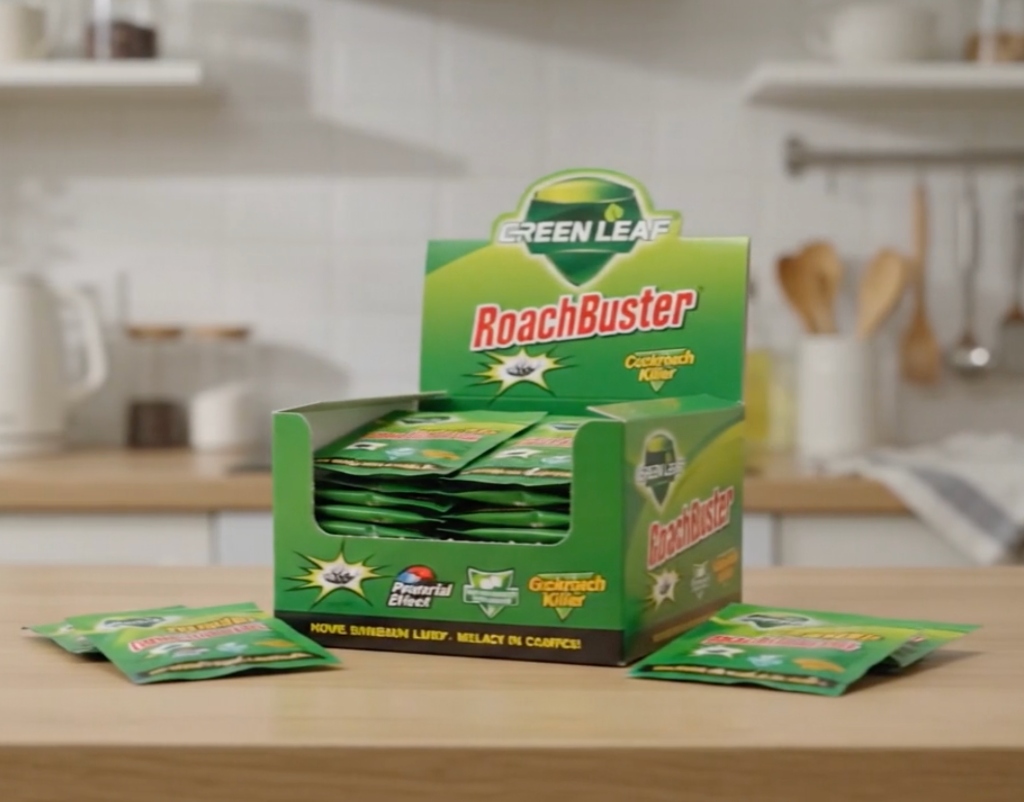
Using RoachBuster for this? This is exactly what the coverage table above is sized for. A single box is $47 with 50 odorless, stainless dry powder sachets, free shipping, and a 30-day money-back guarantee. See the box and bundles.
Always use as directed on the product label, and keep placements away from children and pets.
Where people consistently under-buy
Three patterns come up again and again in homes where a treatment underperformed.
Treating the visible kitchen only
Sightings happen in the kitchen because that is where the light gets turned on at night. The harbourage is frequently elsewhere — under a bathroom vanity, inside a washing machine plinth, behind a boiler. Kitchen-only rounds are why a population dips for ten days and then comes back.
Ignoring the appliance cavities
The warm, dry, undisturbed space behind a fridge or inside a dishwasher surround is prime real estate. If you are not placing there, you are leaving the best habitat in the building untreated. The laundry room guide covers the washer and dryer voids specifically.
Running out and stopping
The most expensive version of this is buying one box, doing an incomplete round, seeing a partial result, and giving up. The population rebounds, and the next attempt starts from scratch. Buying enough to complete a full round plus a top-up is almost always cheaper than two half-rounds. The cost comparison puts real numbers on that.
A note on placement density
More sachets in one cabinet is not better than one sachet in each of five cabinets. Spread beats stacking, because a roach will feed on whatever is inside its own void and rarely travels far. The only time to double up in a single space is when that space is clearly the centre of activity — a heavy cluster under a sink, or a riser cupboard where you can see traffic.
Keep every placement dry and out of reach. Do not put sachets where a child, a pet or a curious hand can get to them, and do not place them on surfaces used for food. Sensible siting is covered in more detail in the clean-home attractants guide, which explains why the moisture and crumb sources matter as much as the bait.
Frequently asked questions
How many sachets are in one box?
Fifty. That is sized to complete a first round in a small to mid-sized home with something left for a top-up, which is why it works as a single-purchase option for apartments.
Is it wasteful to buy more than I need?
Unused sachets keep in their packaging in a cool, dry place, so surplus is not lost. Running out mid-round genuinely does cost you results, so the asymmetry favours buying slightly over.
Can I use fewer sachets and just move them around?
It is much less effective. Roaches feed opportunistically inside their own harbourage; moving a small number of placements around means most voids are untreated most of the time.
Do I need more in an apartment building?
Usually yes, because of shared walls, risers and neighbouring units you cannot treat. Concentrate extra placements on the penetrations where pipes and cables cross into your unit.
How do I know when to place the top-up round?
When you stop finding fresh droppings in a treated void, that void is quiet. When you are still finding them at week two or three, that is the void that needs the refresh.
The short version
Count cavities, not square metres. Budget one sachet per void, two where activity is confirmed, and 35 per cent extra for a top-up round. Studios and one-beds are comfortable on a single box. Two-beds are borderline. Three-bed houses and anything with shared voids should plan on more from the start, because the cheapest treatment is the one you only have to do once.
Treating an active infestation? One box treats one room, once. The 3-Box Kit — $120 (150 sachets, save $59.97) covers a full apartment through the complete 3-4 week treatment cycle; a $47 single box (50 sachets) covers a single-room problem. Ships within 1 business day, typical delivery 6-10 days · Free tracked shipping · 30-day money-back guarantee.
Choose your kit →