
Is Your Roach Treatment Working: Signs of Progress and Stalling
Live sightings are the worst measure of progress. How to read fresh droppings, dead insects and trap catch rates...

When it comes to long-term cockroach control in wall voids, dry powders or dusts are highly effective because they do not break down or evaporate like liquid chemicals. The two most popular DIY options are Boric Acid and Diatomaceous Earth (DE). Understanding the differences between these dusts and applying them safely is critical for successful treatments. For a current head-to-head on dusts, see our comparison of boric acid versus pre-dosed sachets and our ranking of the best roach killer powders in 2026.
Boric acid is a chemical poison. When cockroaches crawl through a light layer of boric acid, the powder clings to their legs and bodies due to static electricity. During grooming, the roaches ingest the powder, which acts as a stomach poison and disrupts their nervous system. Diatomaceous Earth, on the other hand, is a mechanical insecticide. Made from fossilized diatoms, DE acts like microscopic glass, cutting through the waxy outer layer of the roach’s exoskeleton, causing them to dehydrate and die.
The biggest mistake homeowners make with both dusts is applying them too heavily. Squeezing a pile of powder under a sink or along baseboards creates an obstacle that cockroaches will simply walk around. Furthermore, loose, exposed piles of dust can easily be kicked up into the air by pets or HVAC currents, creating respiratory hazards for humans and animals.
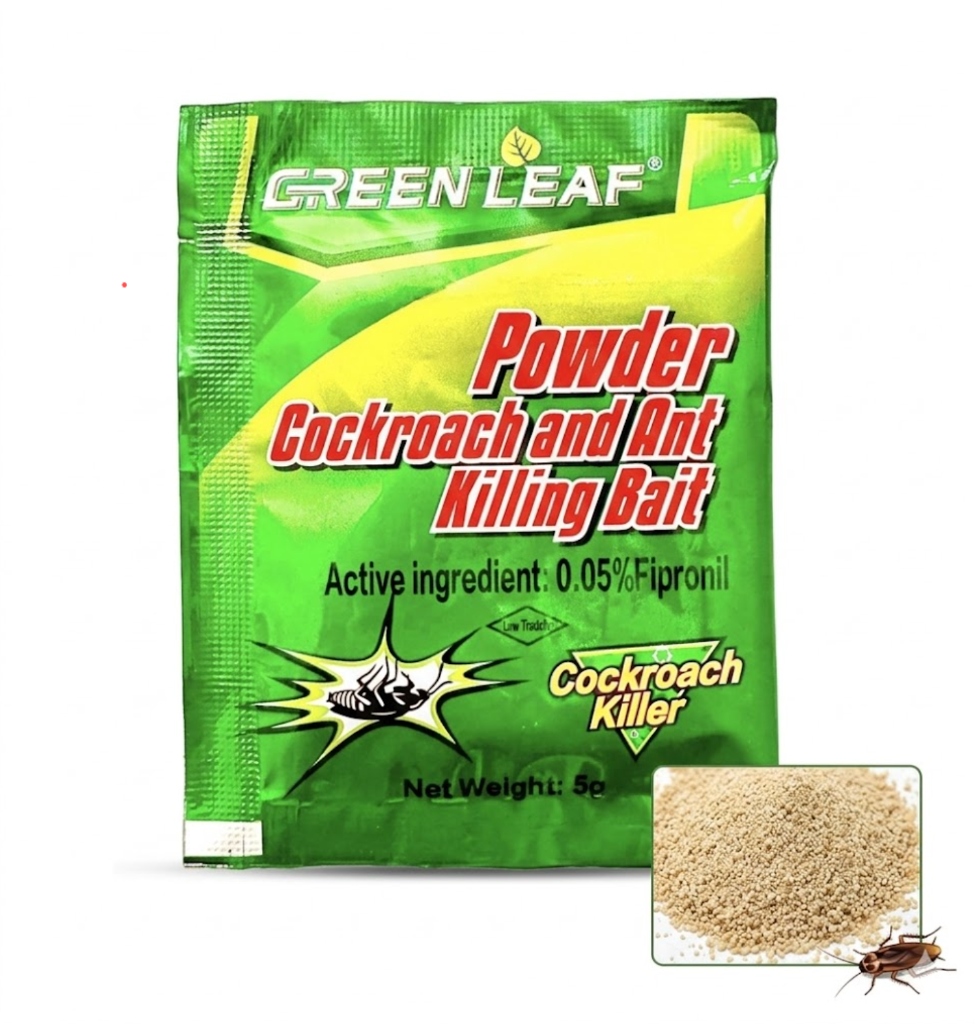
Instead of puffing messy, loose powders that drift into living areas, GreenLeaf RoachBuster offers a cleaner, safer solution. RoachBuster seals its active borate-based dry powder inside specialized paper sachets. Pests chew through the paper, ingest the powder, and carry it away. This method keeps the active ingredient contained, completely eliminating the risk of airborne dust while ensuring the bait remains fresh, dry, and highly effective for months.
Next steps: how many sachets a full round actually takes, how to tell whether a treatment is working, and how powder, sprays and foggers differ.
Boric acid and diatomaceous earth are often shelved together and discussed as interchangeable dusts, but they work in fundamentally different ways and that difference decides where each one is appropriate.
Borates act as a slow stomach poison. The insect has to ingest the material, which in practice happens when it grooms particles off its body after walking through a treated area. Diatomaceous earth is a physical desiccant: the microscopic silica structures abrade the waxy cuticle layer and the insect loses water and dies of dehydration. One is chemical and requires ingestion; the other is mechanical and requires prolonged contact with a dry layer.
| Requirement | Boric acid | Diatomaceous earth |
|---|---|---|
| Application thickness | Barely visible film | Barely visible film |
| Moisture tolerance | Poor; cakes and deactivates | Very poor; useless once damp |
| Route of action | Ingestion after grooming | Physical abrasion and desiccation |
| Speed | Days to weeks | Days to weeks |
| Works against nymphs in voids | Only if they cross it | Only if they cross it |
| Affected by cleaning | Yes | Yes |
| Attractant included | No | No |
The great weakness of both materials is that they need to sit undisturbed, dry and dust-thin. That is impossible in a kitchen where surfaces are cleaned and people walk. It is, however, exactly what a wall void provides: no cleaning, no foot traffic, no moisture in most cases, and no disturbance for years. This is why professional applicators use a bellows duster to place a very light film into voids through existing openings such as socket boxes, pipe penetrations and drilled ports, and why the same materials perform badly when a householder spreads a visible line of powder along a skirting board.
If you are considering void application yourself, three cautions matter. A visible pile is worse than nothing, because insects walk around it. Dust must never be introduced into an electrical enclosure or an appliance cavity. And any void that is damp, such as behind a leaking pipe or in a bathroom wall, will deactivate the material entirely.
Neither material attracts anything. That is the single most important limitation. A cockroach encounters a dust only if its normal route happens to cross the treated surface, and it dies only if it grooms enough material or remains in contact long enough. A bait, by contrast, competes actively for the insect attention and is carried back to the harbourage. That is why dusts are best understood as a supplementary void treatment inside a wider programme rather than as a primary method, and why the comparison of powder, spray and fogger formats matters more than the choice between two dusts. Our article on planning placement counts covers how to build the bait side of the programme.
There is no benefit. You end up with a thicker, more visible layer, which is the main thing that makes dusts fail.
Food grade refers to the crystalline silica content and heavy metal limits, not to inhalation safety. Any fine dust should be applied with respiratory protection and kept out of the air in occupied rooms.
In a genuinely dry, undisturbed void, potentially years. In a damp or disturbed location, days.
Not as a first step, and not at all in rented property without permission. Use existing openings such as socket boxes and pipe penetrations, and put bait at those openings instead, which is usually more effective for the effort involved.
Borates poison after ingestion during grooming; diatomaceous earth abrades and dehydrates. Both need a barely visible, dry, undisturbed film, which is why dry wall voids are the only place they really belong. Neither attracts anything, so treat them as a supplement to bait rather than a replacement. One box of enclosed sachets handles the bait side with no loose dust in living space, and it is backed by a 30-day money-back guarantee.
Always use any product as directed on its label, and keep placements out of reach of children and pets. Product formulations, approvals and labels differ between markets and change over time; this is general educational information, not a substitute for the label or for professional advice.
Treating an active infestation? One box treats one room, once. The 3-Box Kit — $120 (150 sachets, save $59.97) covers a full apartment through the complete 3-4 week treatment cycle; a $47 single box (50 sachets) covers a single-room problem. Ships within 1 business day, typical delivery 6-10 days · Free tracked shipping · 30-day money-back guarantee.
Choose your kit →
Live sightings are the worst measure of progress. How to read fresh droppings, dead insects and trap catch rates...
A resurgence at three weeks and a resurgence at three months are different problems. The six causes of reinfesta...
Powder sachets, aerosols and total-release foggers work on completely different principles. Which one reaches th...
Your anonymous feedback helps us improve our educational home defense resources.