
Odorless Roach Control: What to Use When Sprays Are Off the Table
Asthma, a newborn, a shared ventilation system or a tenancy clause can rule out aerosols entirely. The no-odour ...
For parents of young children and pet owners, discovering a pest infestation triggers a dual crisis. While you need to eliminate the cockroaches immediately to protect your home’s hygiene, you also worry about the health risks of traditional pest control. The fear of chemical exposure, sticky toxic residues, and heavy chemical odors leaves many renters and homeowners searching for a safer, gentler solution. We break down when the $7 bottle is enough — and when it is not — in our boric acid roach killer comparison.
Traditional aerosol pest sprays and professional foggers rely on broad-spectrum synthetic neurotoxins (such as pyrethroids or organophosphates). These chemicals are highly volatile, vaporizing into your indoor air where they can be inhaled by children and pets, and leaving a thin layer of active chemicals on household floors and toys.
In contrast, RoachBuster uses a highly refined dry borate compound. Borate chemistry targets the specific physical structure and digestive system of insects. When pests crawl over the bait, they ingest it during normal grooming. The compound disrupts their metabolic processes and damages their protective exoskeleton, resulting in complete colony elimination. However, because mammals possess highly efficient kidney filtration systems, borates exhibit extremely low toxicity to humans, cats, and dogs, making them an exceptionally secure choice for home defense.
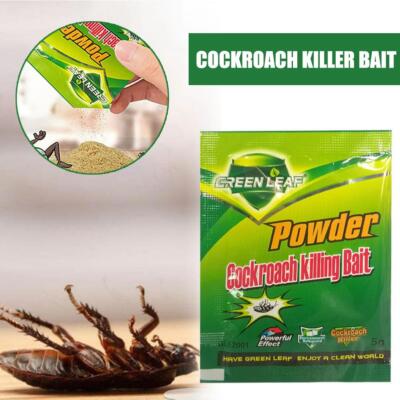
Even with low-toxicity active ingredients, preventing direct contact is the highest standard of household safety. RoachBuster achieves this through its self-contained paper sachet design. The active dry powder bait remains entirely enclosed within thick, durable paper sachets, preventing loose chemical dust from spreading through your home or being picked up on pet paws.
By placing these compact sachets deep within narrow, out-of-reach cavities—such as behind heavy appliances, under bathroom vanities, and inside tight kitchen cabinet corners—you create a highly secure pest barrier. Cockroaches easily slip into the crevices to access the sachets, while your children and pets remain completely isolated from the treatment zones, keeping your family safe and your home completely stainless.
Odour requires volatility. A molecule has to leave the surface and reach the nose to be smelled at all, which is why solvent-based and oil-based formulations announce themselves and why the smell fades as the volatile fraction evaporates. Borate salts are not volatile at room temperature. They are stable inorganic compounds that stay where they are placed, which means there is nothing to enter the air and nothing to smell. The absence of odour is therefore a direct consequence of the chemistry rather than a masking additive or a fragrance-free version of something smelly.
The same property explains two other practical characteristics. Borates do not degrade in sunlight or heat the way many organic actives do, so a dry placement stays active for a long time. And because nothing evaporates, there is no ventilation period and no airborne exposure pathway in normal use, which is the main reason this chemistry suits occupied homes, nurseries, offices and food premises better than aerosols.
The delay is a feature, not a limitation. A fast-acting material kills at the bait station and warns the rest of the population, which is how bait aversion develops. A slow one reaches the individuals you cannot see, which is the entire point.
| Factor | Why it matters | How to control it |
|---|---|---|
| Volatility | Determines whether there is airborne exposure | Choose non-volatile chemistry; no ventilation needed |
| Format | Determines whether material can be touched, tracked or eaten | Enclosed sachet rather than loose powder or open gel |
| Placement | Determines whether a child or animal can reach it | Enclosed cavities behind catches only |
| Dose available | Determines the consequence of an incident | A single small sachet rather than a broadcast layer |
| Label compliance | Determines everything else | Read and follow it, every time |
| Record keeping | Determines how fast an incident can be managed | Keep a placement card and the label |
The practical implications for placement are set out in our coverage arithmetic guide, and the comparison against other formats is in our method comparison.
In a dry, undisturbed, enclosed placement they remain active for months. Moisture is the main thing that ends a placement early, which is why dry positioning matters so much.
Resistance to metabolic stomach toxicants of this type is not documented in the way it is for many neurotoxic insecticides, which is one reason the chemistry has remained useful for a long time. Behavioural aversion to bait matrices is a separate issue and depends on formulation and dosing.
In enclosed cavities away from food and food-contact surfaces, following the label. Never on a worktop, in a food storage area or inside an appliance.
Follow the first-aid directions on the label and contact your local poison information service or doctor immediately, with the label to hand.
Borates are odourless because they are not volatile, which also means no ventilation period and no airborne exposure route in normal use. They work slowly by ingestion during grooming, which is what allows transfer back into the harbourage. Odourless is not a safety claim; enclosure, placement and label compliance are what make a household safe. RoachBuster sachets combine the chemistry with an enclosed dry format, backed by a 30-day money-back guarantee.
Always use any product as directed on its label, and keep placements out of reach of children and pets. This is general educational information about product categories, not toxicological, medical or veterinary advice, and not a substitute for the label of the specific product you buy.
Treating an active infestation? One box treats one room, once. The 3-Box Kit — $120 (150 sachets, save $59.97) covers a full apartment through the complete 3-4 week treatment cycle; a $47 single box (50 sachets) covers a single-room problem. Ships within 1 business day, typical delivery 6-10 days · Free tracked shipping · 30-day money-back guarantee.
Choose your kit →

Asthma, a newborn, a shared ventilation system or a tenancy clause can rule out aerosols entirely. The no-odour ...
Exposure routes differ by species: dogs nose out floor-level items, cats groom residue off their paws, birds and...
Toxicity depends on the product, the amount and the animal, so the useful question is how to reduce the dose tha...
Your anonymous feedback helps us improve our educational home defense resources.