When you spot a cockroach scurrying across your kitchen counter, your immediate reaction is to grab a can of aerosol spray. Aerosols like Raid provide instant gratification by freezing and killing the target bug on contact. However, behind this quick fix is a counterproductive biological side effect: spraying repellents makes the overall infestation significantly worse. Roaches walking past your placements? See the five real reasons in roach bait not working, then compare formats in our best roach killer powder guide.
The Repellent Barrier and the Scatter Response
Aerosol sprays contain synthetic pyrethroids designed to act as strong repellents. When you spray along your kitchen baseboards, under cabinets, and around door frames, you create a chemical barrier that roaches find highly offensive. Instead of crossing the barrier and dying, the colony triggers a survival scatter response. The nesting center splits, and the cockroaches flee deeper into untreated zones like wall cavities, ceiling voids, and electrical outlets.
Spreading the Infestation to Other Rooms
By repelling the colony, you drive the pests out of the kitchen and into areas where they normally wouldn’t nest, such as bedrooms, closets, and living room couches. In apartments, this scatter effect forces roaches to migrate through walls into neighboring units. Once the chemical spray breaks down in a week or two, the insects return to forage, forcing you to spray again, creating a frustrating, endless cycle.
The Solution: Non-Repellent Dry Baiting
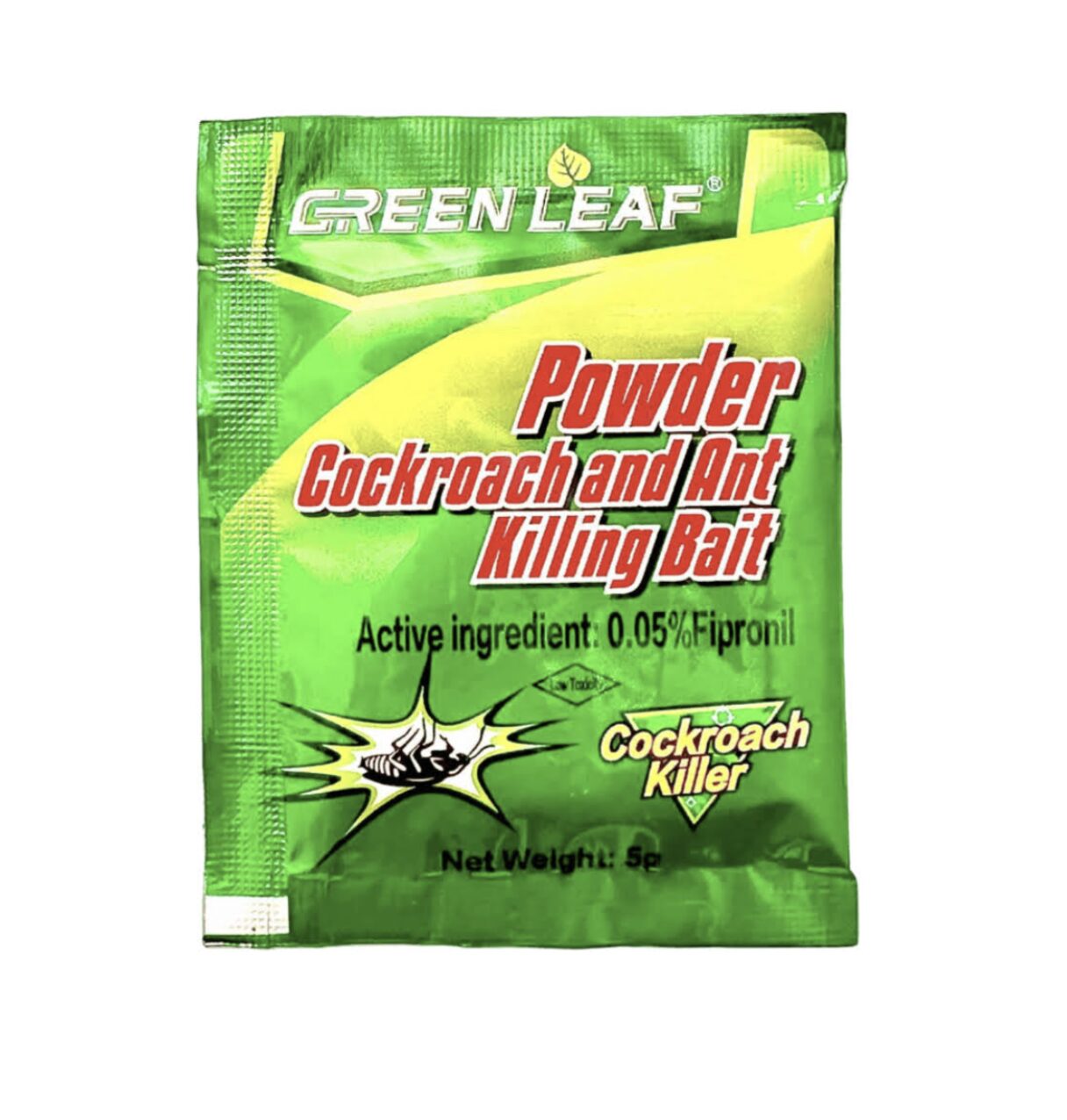
To eliminate a cockroach infestation permanently, you must stop repelling the insects and start drawing them to a non-repellent bait. GreenLeaf RoachBuster sachets use an odorless, dry borate formula that cockroaches cannot detect. They feed on the bait naturally and carry fine particles back to the nesting center. Because there is no chemical repellent to alarm them, the entire colony remains localized and is eradicated at its source, resolving the problem for good.
Next steps: how powder, sprays and foggers differ, how to tell whether a treatment is working, and how many sachets a full round actually takes.
What a knockdown aerosol is designed to do
Consumer contact aerosols are engineered around one measurable outcome: rapid knockdown of the insects you can see. That is a genuine capability and it is why the category exists. The formulation typically pairs a fast-acting pyrethroid with a solvent and a propellant, and it works on direct contact within seconds. The problem is that the design goal, visible insects dying quickly, is almost unrelated to the goal you actually have, which is a population reduced to zero over the following weeks.
Two properties of that design create the damage. The formulation is repellent, so insects that are not hit directly move away from the treated surface. And the effect is confined to the surfaces the spray reaches, which excludes the wall cavity, the appliance motor bay, the plinth void and the plumbing chase where most of the population actually is.
The three ways an aerosol makes a household worse off
- It disperses the population. Insects leave the treated area through the nearest void and establish new aggregations in previously clean rooms, or in a neighbouring flat. One harbourage becomes several, and you no longer know where they are.
- It contaminates the surfaces you need for bait. Repellent residue on a cabinet floor makes any bait later placed there much less likely to be accepted. Households frequently conclude that bait does not work when what actually happened is that the surface was pre-treated.
- It hides the trend. Because visible insects die, sightings fall for a few days and the household concludes the problem is resolved. Meanwhile the population continues developing in the voids, and the next generation appears three to six weeks later, usually in greater numbers and in more rooms.
Aerosol versus bait, honestly compared
| Property | Contact aerosol | Non-repellent bait |
|---|---|---|
| Kills visible insects | Immediately | No; visible insects are irrelevant to the outcome |
| Reaches insects inside voids | No | Yes, via foraging and secondary transfer |
| Effect on aggregation | Disperses it | Leaves it intact while reducing it |
| Residue on surfaces | Yes | None from an enclosed sachet |
| Odour | Usually strong | None |
| Suitability with pets and children present | Poor; requires removal and ventilation | Good, when placed in enclosed positions per the label |
| Effect on subsequent bait acceptance | Reduces it | Not applicable |
| Timeline to a quiet home | Days of relief, then recurrence | Two weeks to visible reduction, four to six to quiet |
Where aerosols still have a legitimate use
- Killing a single large insect you want removed immediately, in a room you are not treating with bait.
- Wasp and flying insect situations, which are a different problem entirely.
- Targeted professional applications as part of an integrated programme, chosen deliberately by someone who knows what else is in place.
What they should not be used for is an active German cockroach harbourage, a wall void, a shared wall, an appliance cavity, or any surface where you intend to place bait. Our method comparison sets out what each format can and cannot reach, and our article on why treatments fail and populations return covers the recurrence pattern that follows aerosol-led treatment.
Recovering from repeated aerosol use
- Stop entirely. Every further application widens the dispersal and deepens surface avoidance.
- Wash treated surfaces with plain detergent and warm water, particularly cabinet floors and corners where you plan to place bait.
- Re-inspect the whole property, not just the original room, and include adjacent rooms and the other side of any shared wall.
- Use overnight monitors to locate the current aggregations rather than assuming they are where they used to be.
- Place bait densely across every location the monitors flagged, using the counts in our coverage arithmetic guide.
- Remove competing water and food overnight so the bait is the most attractive resource available.
- Allow four to eight weeks rather than two to four, and keep placements in position through the hatch window at weeks four to six.
Questions people ask
Why did spraying seem to work the first time?
It killed the insects you could see. The population was in the voids, unaffected, and it reappeared once the next stage matured.
Is it dangerous to have sprayed a lot indoors?
Follow the ventilation and re-entry directions on the label, wash food-contact surfaces, and be particularly careful in homes with asthma, infants, pets, birds or fish. If anyone has symptoms, seek medical advice.
Can I spray and bait at the same time in different rooms?
It is not advisable. Dispersal from the sprayed room typically moves the population into the baited room and into surfaces you have not treated, and the two approaches work against each other.
What should I use for the one insect I can see right now?
A glass and a piece of card, or a paper towel. Removing one insect physically avoids contaminating the surfaces your treatment depends on.
The short version
Knockdown aerosols are designed to kill what you can see, which is not the population. They disperse aggregations, contaminate the surfaces bait needs, and mask the trend so the problem returns larger. Stop, wash the residue off, re-inspect widely, place non-repellent bait densely and allow four to eight weeks. One box of fifty sachets covers a full recovery round, with a 30-day money-back guarantee.
Always use any product as directed on its label, and keep placements out of reach of children and pets. Product formulations, approvals and labels differ between markets and change over time, so read the label of the specific product you buy rather than relying on general category descriptions.
Treating an active infestation? One box treats one room, once. The 3-Box Kit — $120 (150 sachets, save $59.97) covers a full apartment through the complete 3-4 week treatment cycle; a $47 single box (50 sachets) covers a single-room problem. Ships within 1 business day, typical delivery 6-10 days · Free tracked shipping · 30-day money-back guarantee.
Choose your kit →